
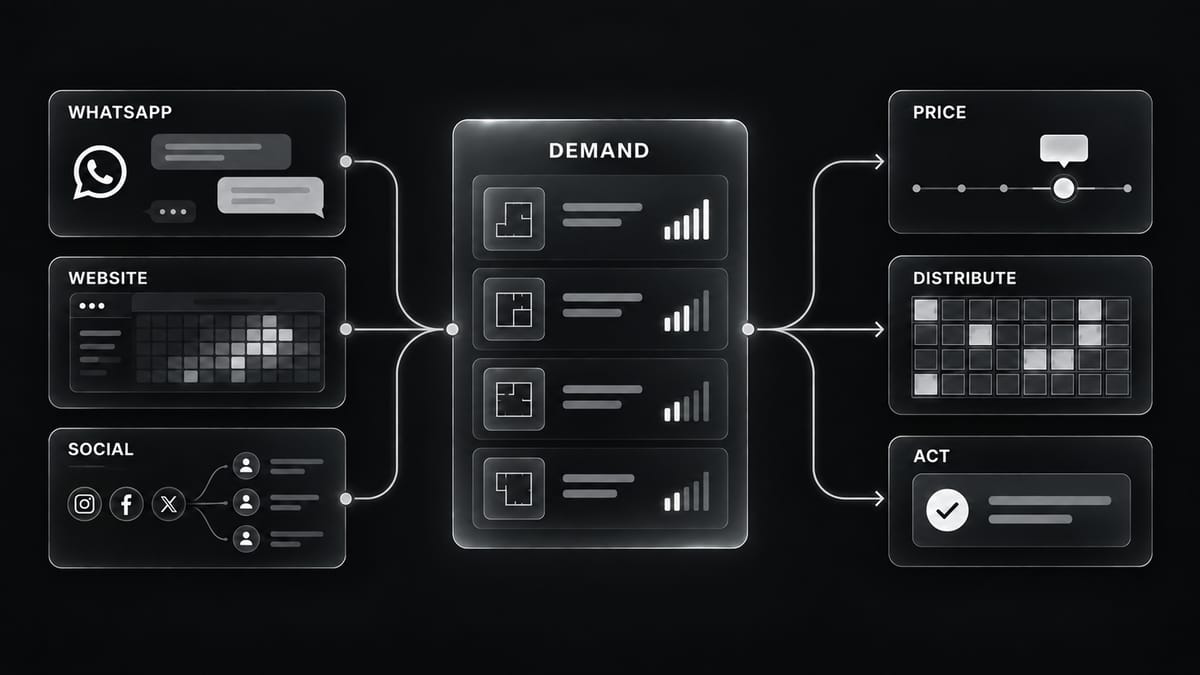
Your team has taken calls today. Brokers have sent WhatsApp messages about particular units. Buyers have opened payment plans, returned to project pages and asked whether a unit can be held. Your social campaigns have generated another set of responses. Each interaction says something about demand, but they arrive in different places and at different moments in the day.
The evidence is already there. The question is whether it becomes useful before the next commercial decision has to be made.
This guide shows you what to collect from the activity around a live project, how to connect it to the decisions that matter, and how to use it without creating another reporting job for your sales team. The aim is not to produce a more elaborate dashboard. It is to give you better grounds for deciding what to price, what to offer, where to put attention and how to launch the next project with more knowledge than the last one.
The activity around a unit is not all the same
An enquiry count is a useful starting point. It tells you that people are looking. It does not tell you what they are doing next, why they are interested, or whether a commercial response is needed.
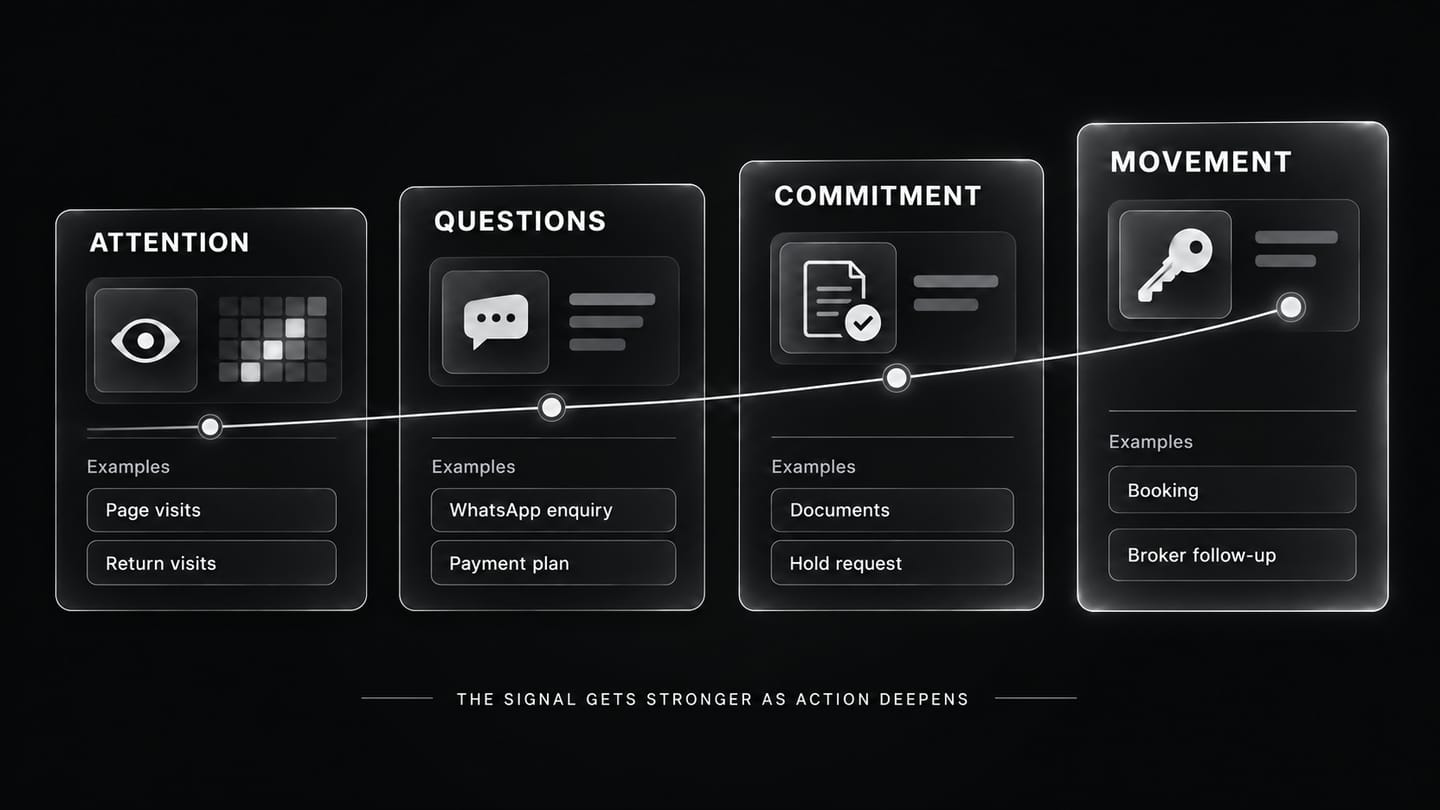
That distinction matters because attention, questions, commitment and movement are different signals.
Attention may be someone viewing a project page, returning to a unit type, opening a brochure or responding to a social campaign. It can show that a message, location or unit has caught interest. But attention alone is not a reason to change a price.
Questions are stronger. A WhatsApp conversation about a payment plan, a request for a floor plan or a buyer asking about a specific view tells you where the interest is becoming more concrete. It still needs context. A question about a unit can mean the buyer is close to a decision, or simply that the information was not easy to find.
Commitment is stronger again. A document request, a broker asking for an allocation, a buyer sharing information for KYC, or a request to hold a unit signals that somebody is trying to move the deal forward. Movement is what happens after that: whether the hold becomes a booking, whether the buyer continues, and whether the broker brings another qualified enquiry.
The value is in seeing the sequence, not just seeing each event on its own.
Why a channel report is rarely enough
It is natural to report enquiries by source. You may want to know how many came from a campaign, the project website, a broker or a WhatsApp number. That view is helpful, but it leaves out the part that turns activity into intelligence.
Treating every enquiry equally is the other natural mistake. One person who spends ten minutes comparing a payment plan, requests the documents and asks to hold a unit is not the same signal as ten people who glance at a project page and leave. Both are real activity. They should not lead to the same decision.
For an activity record to be useful commercially, it needs a few anchors. It should be organised around:
- the project and, where possible, the unit or unit type;
- the brokerage or buyer-facing activity involved, where that context is available; and
- the action they took and the channel where it happened; and
- the time it happened, so patterns can be read over time.
This is how a page view becomes more than a page view. If activity around the same two-bedroom unit includes payment-plan questions and document requests over a short period, that pattern matters. If a broker repeatedly asks about a unit type and stronger buyer actions follow, that pattern matters too. If a social response raises attention but rarely leads to questions about a specific unit, that matters for a different reason.
It lets you read demand as behaviour rather than as a pile of contacts.
An illustrative ten days on one project
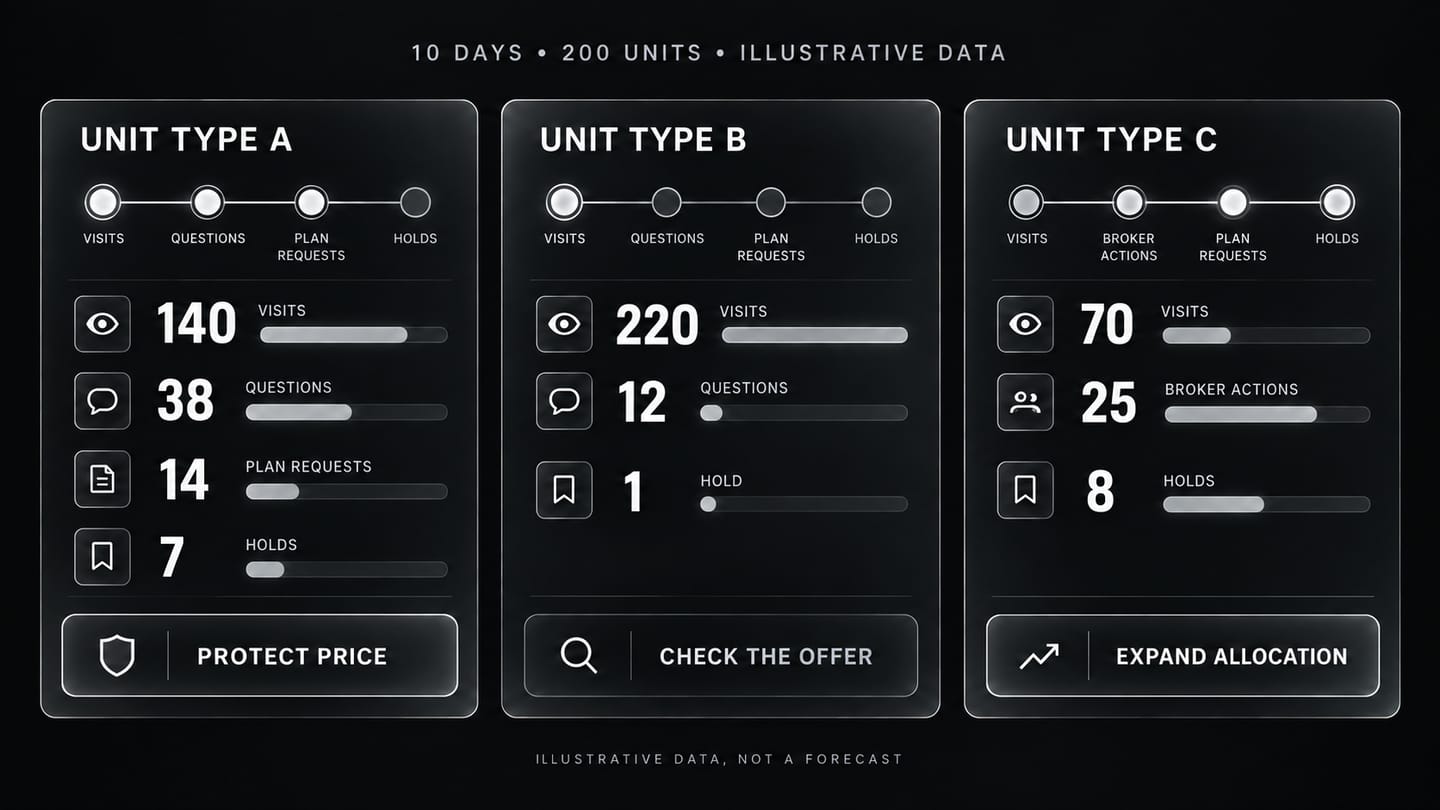
Take a live project of 200 units. The following is illustrative, not a forecast or a customer result. Over ten days, you organise activity around three unit types and read the patterns over time, including the broker actions and buyer responses around each type.
Unit type A receives 140 project-page visits. It generates 38 WhatsApp questions, 14 payment-plan or document requests and 7 holds. The messages are not all identical, but a pattern appears: people are asking about the same view, handover timing and payment-plan detail before they ask to hold a unit.
Unit type B receives 220 page visits, more attention than A. Yet it produces only 12 questions and one hold. The page is being seen, but people are not moving through the same sequence. You might look at the offer, the payment-plan presentation or the way this unit type is described before assuming that the answer is a price reduction. The activity tells you to examine the gap between attention and progress.
Unit type C receives only 70 page visits. But brokers take 25 actions around it, including allocation requests and conversations with prospective buyers, and 8 holds follow. The demand is being carried through a channel that would look modest if you only watched website traffic. It may be sensible to make more of that unit type available to the brokers creating serious movement, while checking that the allocation remains fair and aligned with the project plan.
Now the decisions have a basis.
For A, you may decide to protect the current price while interest is progressing to holds. There is no need to promise that it will keep doing so. The point is that you have evidence before you make a commercial change.
For B, you may test whether the offer or payment-plan explanation is meeting a real concern. The next step might be a clearer document, a more appropriate commercial option or a conversation with the buyers and brokers closest to those enquiries. The evidence says attention is present but is not becoming commitment. It does not tell you, by itself, which change will solve that.
For C, the broker activity may support a decision to allocate more of the relevant units to the brokerages that are bringing qualified demand. It can also help you distribute the project without loading follow-up onto the same few people. You can see where leads are active, which enquiries have reached a meaningful stage and where a team member needs to respond.
The numbers are only useful because they are connected. A raw total of 430 visits, 50 questions and 16 holds would tell you far less.
Price against movement, not noise
Pricing is often discussed as a single decision made at launch. In practice, it is a series of commercial judgments as a project moves. You decide what to protect, what to examine and when an offer is appropriate.
Private demand intelligence gives those judgments a clearer starting point. It shows whether a unit is drawing repeated, specific interest, whether the conversation is moving from questions to documents and holds, and whether certain unit types are attracting interest through brokers rather than directly through the project site.
That does not mean a system should price a property on its own. Pricing remains your decision, based on the project, your commercial plan and the market context you know best. The intelligence helps you distinguish a real pattern from a busy inbox.
The same applies to discounts and offers. A discount can be a considered response to a unit that has stayed quiet despite clear visibility and follow-up. An offer can answer a question that buyers repeatedly raise as interest develops. Neither should be a reflex because an enquiry count looked low on one day. When activity is read as a pattern over time, your team can see whether a unit needs a commercial response, better information, different distribution, or simply time.
Balance the enquiries before they become a queue
The workload around a launch is uneven by nature. A few unit types can draw most of the questions. A broker can send several buyers in one afternoon. A message arriving on WhatsApp can require a document, an allocation check or an approval before it becomes useful to the buyer.
If the signals are connected, your team does not have to treat all incoming work as one queue. They can prioritise based on what has happened: a payment-plan request around a unit that is receiving repeated interest, a broker whose allocation request relates to active demand, or a hold that needs a timely decision.
This also improves coordination. Sales, commercial and broker-facing teams can work from shared context around the project and the units receiving attention. It reduces the risk of a person being asked the same questions twice or a unit being discussed without the latest context. Your existing process remains yours. The purpose is to make its live activity easier to act on.
Project distribution becomes clearer as well. You can see which brokers are working particular unit types, where their leads are moving, and where more inventory or support could be useful. Allocation is then connected to evidence of activity, not only to a broad expectation about who may perform.
Keep the evidence after the launch
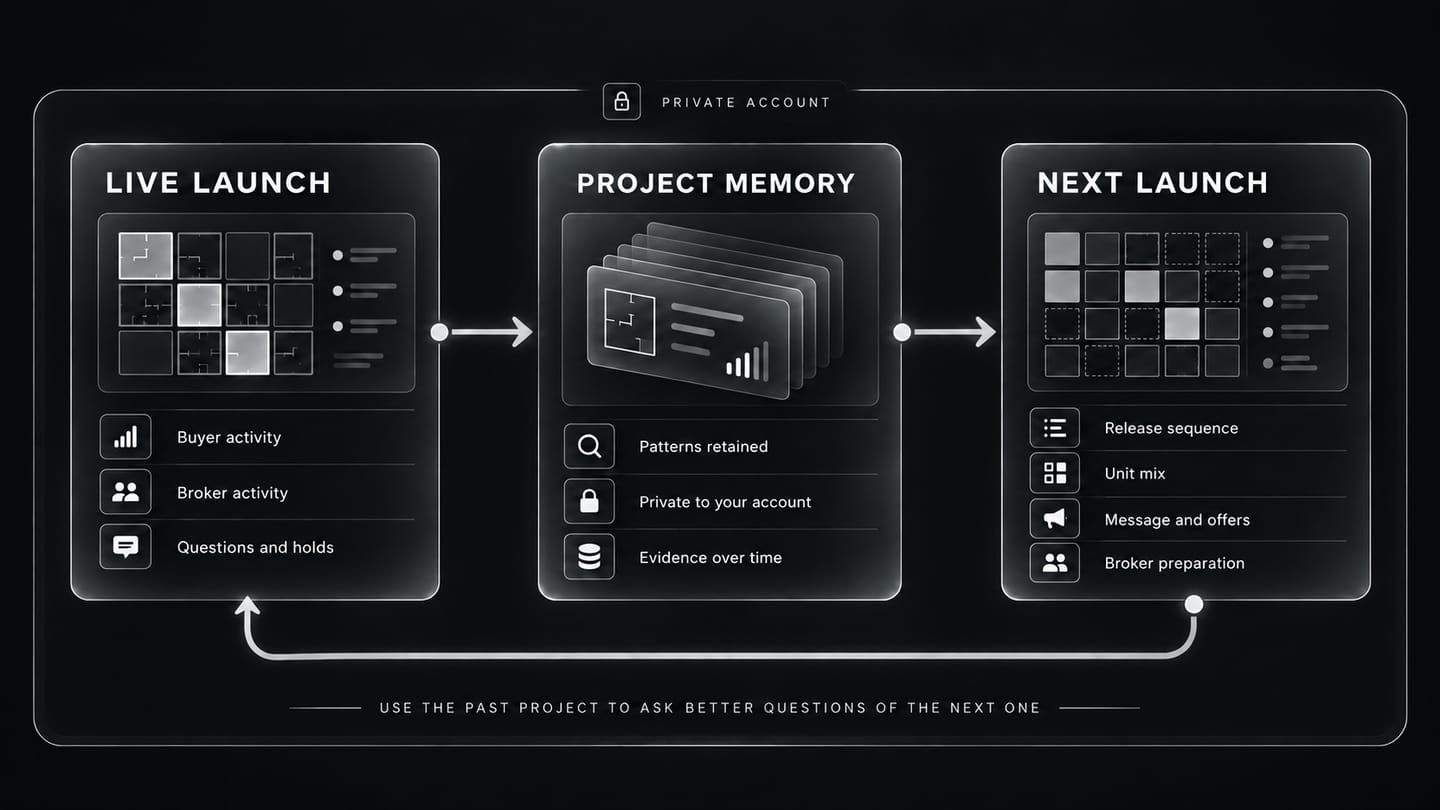
The intelligence from one project should not disappear once the sales cycle moves on. It is one of the most useful inputs you have for the next launch.
Over time, you can look back at which messages drew useful questions, which unit types moved first, what buyers needed before committing, how payment-plan questions changed by stage, and which broker routes created real progress. You can compare patterns across your own launches without pretending that the next market will behave exactly like the last one.
That gives you informed judgment about release sequence, unit mix, the questions a campaign should answer, the commercial approach you want to prepare and the broker distribution you want ready from day one. It is not certainty. It is a more useful starting point than beginning each project with no structured memory of the activity around the last one.
“This sounds like another reporting project my team has to maintain.”
It is a fair concern, and it deserves a direct answer. If collecting the data means asking people to tag conversations, update spreadsheets and prepare weekly reports after a full day of selling, it will soon become incomplete. The information will be least reliable when the project is busiest.
Automation is the point. Proptera intelligence reads heat maps, WhatsApp conversations, broker actions and buyer actions. Website activity and social responses also feed the analysis. The aim is to automate collection and make patterns around a project and its units easier to read, not create another reporting job for your team.
The intelligence remains personal to the account. A developer sees its own units and activity. A brokerage sees only the units allocated to it and its own live pages. The information is not pooled or shared between accounts.
You still make the commercial decisions. Proptera helps give those decisions evidence.
When intelligence can lead to work being completed
Once you can see where demand is forming, the next question is what happens to the work around it. A buyer may need the payment plan. A broker may need an allocation or a hold. Your team may need an approval, a price change or a clear view of what is happening before deciding how to proceed.
This is where Proptera’s AI agent enters. It gives your team, brokers and buyers a conversational way to complete the work each user has permission to do around live inventory, with each user seeing only their own scope. The agent can help move the requests that follow demand forward, while the intelligence helps you see which decisions deserve attention. It is not a separate reporting exercise sitting beside the sales process.
Proptera works alongside the tools and channels you already use. The intent is to connect the work and evidence around a project so your people have a clearer basis for action.
Start with one live project
The practical way to begin is the Proptera pilot. We load the project, units and payment plans, set the agent up for your team, brokers and buyers, bring the brokerages on, and run one project alongside your people.
That gives you a live place to decide which signals matter to your commercial plan. You may begin with three questions: which unit types are moving from interest to holds, where buyer interest is slowing, and which broker activity is followed by stronger buyer actions. The questions will be yours. The pilot gives the project activity somewhere useful to go.
Choose one live project this week and write down the three commercial questions its activity should answer. Use that project as the pilot.