
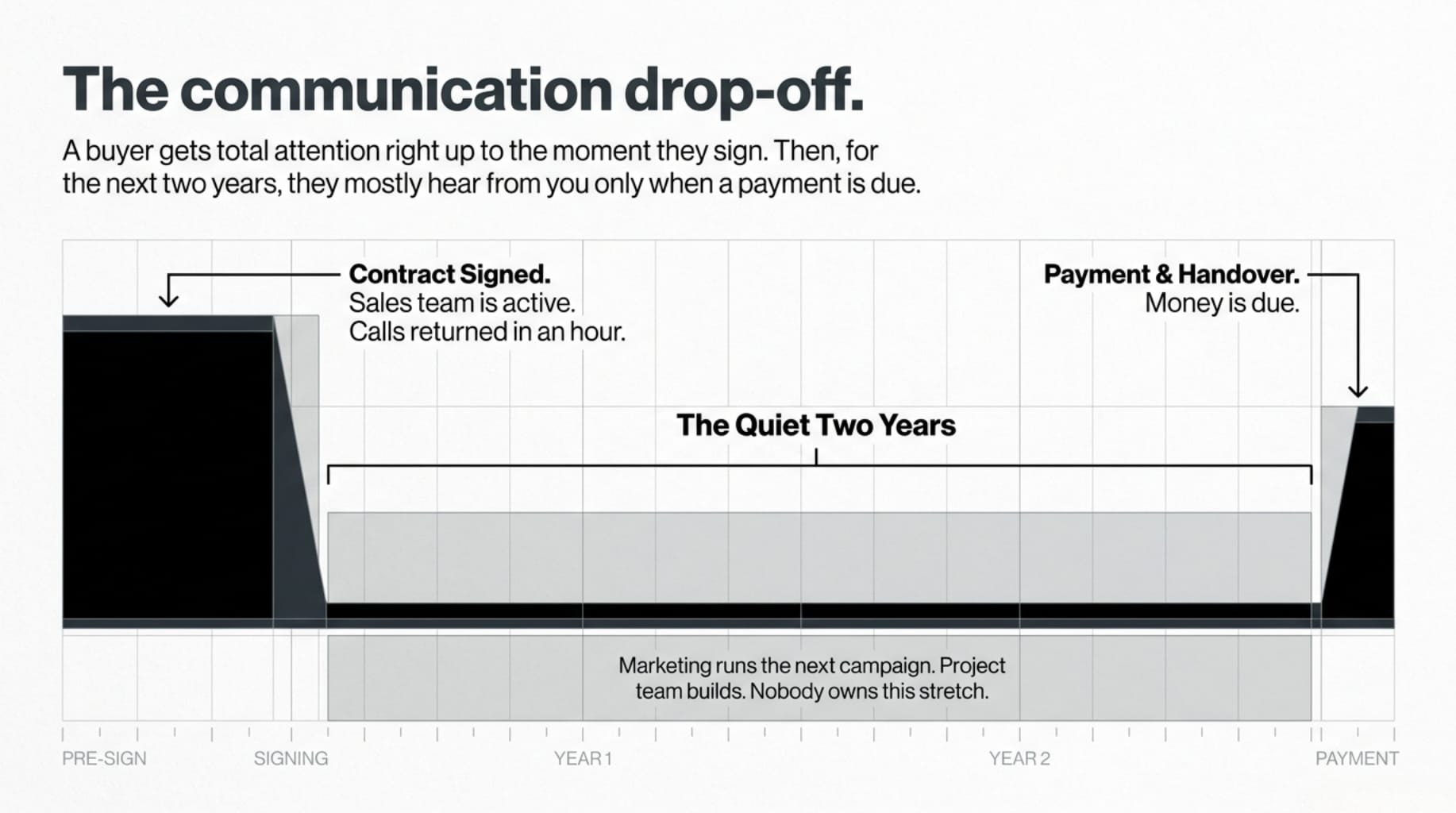
A buyer gets a lot of attention right up to the moment they sign. Calls returned within the hour, questions answered the same day, a name they can reach. Then they sign, and for the next two years they mostly hear from you when a payment is due.
It is not neglect. The sales team has moved to the next launch, marketing is running the next campaign, and the project team is building. Nobody decided to go quiet. It just happened, because no one owns that stretch.
That stretch is where referrals are won or lost, where cancellations start, and where the volume of inbound questions gets decided. It is also the cheapest part of the whole journey to get right, because nearly all of it can be planned once and repeated for every buyer.
Four questions, asked over and over
Every question a buyer asks between contract and handover is a version of one of four:
- Is it being built. They want evidence, not assurance. A photograph does more than a paragraph.
- Is it on time. Including when it is not. Especially when it is not.
- What do I owe and when. Ahead of the demand, not with it.
- What do I need to do next. Most buyers do not know what is expected of them, and they are reluctant to ask in case the answer is that they have already missed something.
Answer these before they are asked and the inbound volume drops. That is the whole idea behind everything below.
A plan you can actually run
Set the schedule on the buyer's own timeline, counted from their contract date, so every buyer gets the same experience regardless of when they bought.
| When | Send | Why it matters |
|---|---|---|
| Within 48 hours of signing | Welcome. Their unit, their plan, what happens next, and the name and contact of one person | Buyer's remorse is real and it peaks in the first week. This is the message that does the most work |
| Week 2 | A short orientation: how updates will work, how often, and where to ask questions | Sets expectations, which is what prevents the anxious calls later |
| Every quarter | Construction update with photographs, the milestone reached, and the next one expected | The backbone. Quarterly is enough if it is reliable |
| Two to three weeks before each payment | Advance notice: amount, date, how to pay, and the reference to use | Improves collection and removes the sense of being surprised by demands |
| At each milestone | Confirmation the milestone was reached and certified | Connects the money to the building, which is the connection buyers most want |
| Halfway | A fuller update: progress, what remains, anything that has changed | The point at which a long build starts to feel like it has stalled, whether or not it has |
| Six months out | Handover is approaching, what the process will be, what they should start arranging | Buyers need lead time for funding, mortgage arrangements, and moving |
| Two to three months out | The handover process in detail, with the documents and payments needed | Removes most of the last minute chaos that makes handover week difficult |
| Two weeks out | The appointment, what to bring, who to contact, what happens on the day | A confident buyer on handover day is a better handover for everyone |
| After handover | How to report a defect, who to contact, and what the warranty covers | The message that decides what they say about you |
Ten messages over two years. That is not a heavy load. What makes it work is not the volume, it is that it arrives.
Reliability beats frequency
A quarterly update that always arrives builds more confidence than a monthly one that sometimes does not. Buyers notice a missed update, and they read silence as a problem, usually a worse problem than the one you actually have.
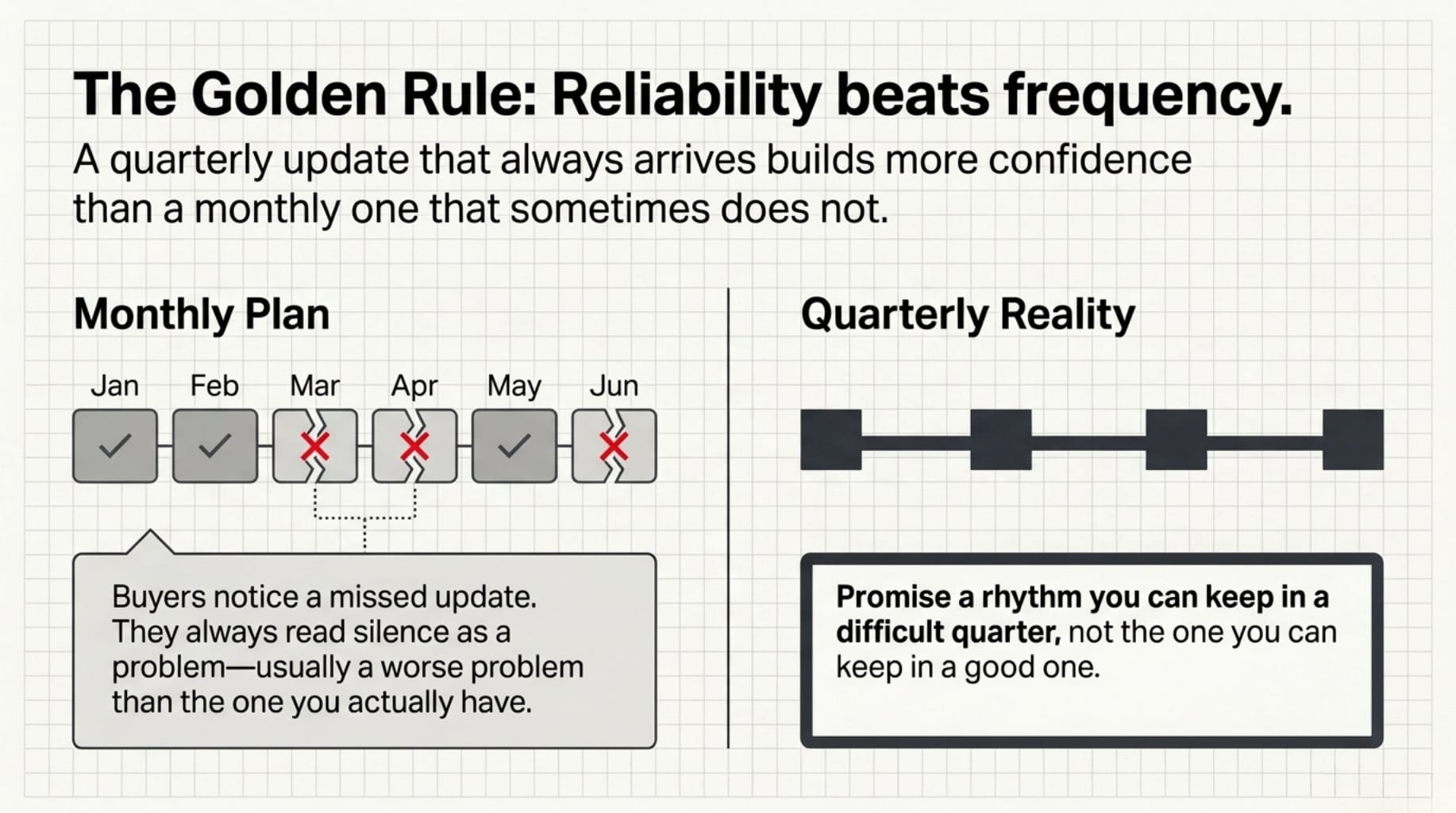
So promise a rhythm you can keep in a difficult quarter, not the one you can keep in a good one.
When the news is bad
Delays happen on real projects. What buyers remember afterwards is not the delay, it is how they found out about it.
The instinct is to wait until there is a new date to give. That instinct is wrong, because the waiting is where the trust goes.
- Tell them before they hear it elsewhere. Buyers visit sites, follow local groups, and talk to each other. Being the last to know is worse than the delay itself.
- Say what happened, plainly. Not "unforeseen circumstances". A real reason is easier to accept, and it is what people repeat to others on your behalf.
- Give a date you can hold. A second slip costs far more than the first, because it removes the value of anything you say afterwards.
- Say what it changes for them. Payments, handover, anything they had arranged around the old date. This is the part they are actually asking about.
- Send it to everyone at once. Staggering the message means buyers compare notes and conclude they were told different things.
- Be available afterwards. Send difficult news when someone is there to answer the phone, not on a Thursday evening.
The reason the plan usually fails
It is almost never the plan. It is that nobody has the material. Marketing cannot write a construction update they have no photographs for, and the project team has other things to do that week.
Four things fix most of it:
- Same angles every time. Three or four fixed viewpoints, photographed monthly. The comparison between them is what buyers find compelling, and it takes minutes on site.
- One named person on the project side. Their job is the two lines of context that make the photographs mean something, not writing the update.
- Templates, filled rather than written. Same structure every quarter. Buyers learn where to look, and production stops depending on who happens to be available.
- Approval agreed in advance. Who signs off, and in how long. Most late updates are late in approval, not in drafting.
Knowing whether it worked
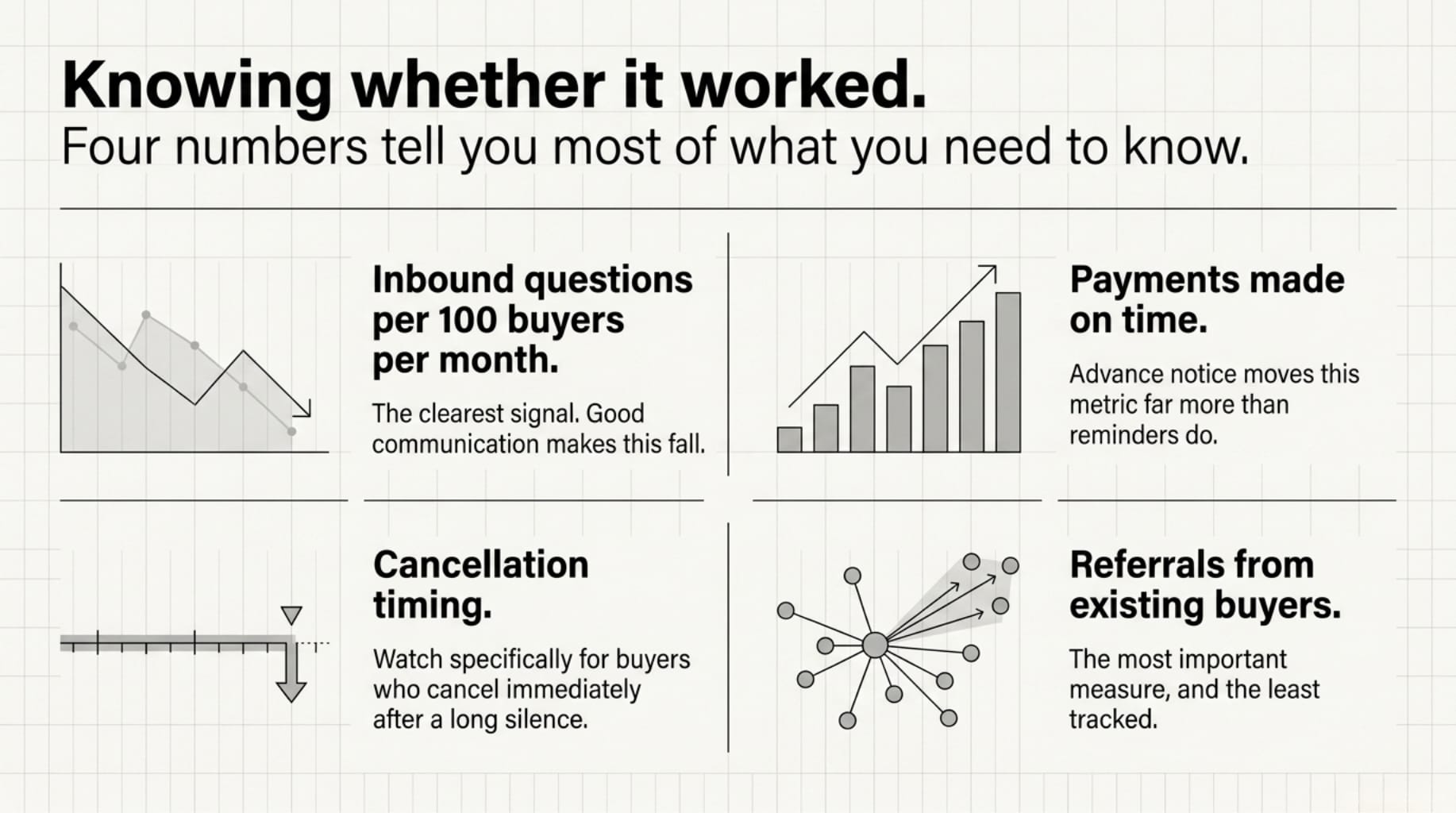
Four numbers tell you most of what you need:
- Inbound questions per hundred buyers per month. The clearest signal. Good communication makes this fall.
- Payments made on time. Advance notice moves this more than reminders do.
- Cancellations, and the reasons behind them. Watch for buyers who cancel after a long silence.
- Referrals from existing buyers. The measure that matters most and the one nobody tracks. Ask at handover where the buyer heard about you.
A note on the two markets
In the UAE, a large share of off plan buyers are outside the country and will never see the site, so photographic evidence carries more weight here than almost anywhere else. Where payment plans are tied to construction milestones, pair every milestone confirmation with the payment it triggers, so the two arrive as one message rather than the payment appearing on its own.
In the UK, buyers are typically committed at exchange with the balance due at completion, so the anxiety concentrates on when completion will happen and how much notice they will get. That makes the six month and three month messages the most valuable on the list, because mortgage offers have their own expiry dates and buyers need real time to arrange funding.
Requirements about what buyers must be told, and when, differ by emirate and by UK nation, and they change. Treat the above as a communication plan and confirm the specifics with your own advisors.
If this is on your list
Most of this plan is repeatable, which means most of it can be handled in one place rather than chased down each time. That is a large part of what Proptera does alongside the systems you already run: buyer records, payment schedules, and a portal where buyers can see their own unit, their plan, and where things stand.
If keeping buyers informed between contract and handover is something you want to make routine, book a walkthrough and we will go through it on your own projects.