

Launch weekend went well. A good share of the tower went in the first few days, the broker event did its job, and the sales director sent the numbers round on Sunday evening.
Then the project entered its second life. The campaign budget moved to the next launch, two of the strongest people on the floor went with it, and what remains is a list of units that did not go in the first rush. The list has been roughly the same length for four months.
Nobody decided to stop selling them. Nothing on anyone's calendar says the remaining units are their job this week.
This is about that part of a project: why the tail is harder than the launch, what it costs while it sits, and a way to run it that does not depend on anyone having spare time. Most of it you can set up with the inventory list you already keep.
The market moved from launching to delivering
Two things changed in Dubai this year, and they changed at the same time.
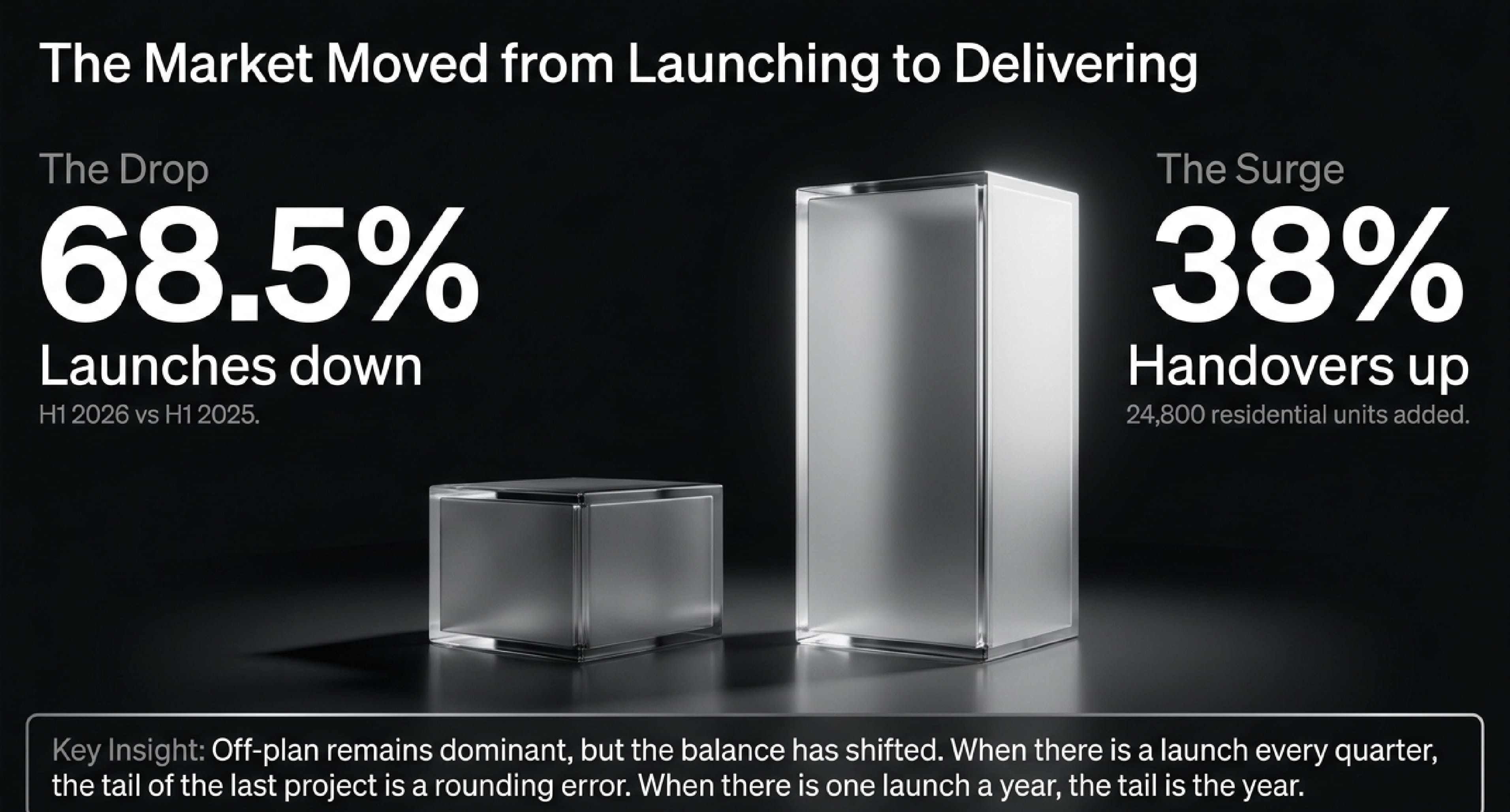
Developers launched far less. Cavendish Maxwell recorded 124 project launches in the first half of 2026, covering about 28,000 units, against 410 launches and roughly 102,000 units in the first half of 2025. Over the first five months of the year, new launches were down 68.5 per cent year on year.
Meanwhile handovers rose. Dubai added around 24,800 residential units in the first half of 2026, 38 per cent more than the same period last year, with a substantial pipeline of scheduled completions still ahead.
Sales eased as this happened. Transactions and values both fell by double digits over the half, and by August average sale prices were down 1.7 per cent year on year, the first annual decline since February 2021.
Off-plan is still where the market is, at roughly three quarters of Dubai residential sales in the first half. What has moved is the balance inside a developer's year: fewer new launches to carry the number, and more existing inventory to sell through while buildings top out.
That is an observation about workload, not a market forecast. When there is a launch every quarter, the tail of the last project is a rounding error. When there is one launch a year, the tail is the year.
Why good teams leave the tail alone
The tail is left alone by capable people for reasons that make sense at the time.
A launch is a single event with a date, a budget and an owner. The remaining units are a slow, open-ended job with none of those three. Work with a date beats work without one, every week, in every company.
The remaining units are often the harder ones. The early buyers usually took the most obviously marketable stock, though plenty of developers release in phases or hold premium units back on purpose. Either way, what is still there tends to be the inventory that needs a reason, and the reason is usually a better explanation or a better commercial structure rather than a bigger campaign.
And the reporting hides it. Most project reporting is at project level: units sold, value sold, percentage sold. At 74 per cent sold, a project reads as a success. The units inside that last 26 per cent are never visible as individual problems, so they are never treated as individual problems.

What the tail costs while it sits
Some unsold units are held back on purpose, and those are a decision rather than a problem. The rest carry four costs, and none of them appear as a line anyone shows you.
Cash timing. Buyer payments on sold units go into the project escrow account, and what comes out is governed by construction progress and the regulator's rules. Every unit still unsold is a share of the build funded some other way, through equity or project finance.
Price integrity. Reactive discounting is where margin quietly goes. Cutting a price near handover, under pressure, fixes the unit with the most expensive lever available. Deciding earlier guarantees nothing, because markets move both ways, but it does mean price is chosen from a set of options rather than reached for when nothing else is left.
Broker goodwill. A brokerage that was allocated units at launch and has heard nothing since will put its attention on the developer who answers the phone. Allocation without follow-through quietly costs a channel.
Attention going to the wrong units. Without a unit-level view, effort spreads evenly across whatever is left. Some of those units need a price decision, some need a floor plan explained properly, and treating both the same way spends the only thing in short supply, which is your team's time.
A way to run the tail
Four moves. None of them require new software to begin.
1. Give the remaining inventory an owner and a standing review. One named person, one recurring meeting, one list. Monthly suits a settled tail; a block just released, or one approaching handover, will need looking at more often than that. The point is not the meeting. The point is that the list has somebody whose week it belongs to.
2. Age every unit, not every project. Start a clock on each unit from the day it was released for sale, not from launch day. Sort the remaining stock by that number. A project that is 74 per cent sold tells you nothing useful. A list showing eleven units past 400 days tells you where to look.
3. Ask three questions before you touch the price. A useful first pass is to separate three common failure modes, in this order.
| Question | What it looks like | Where to look first |
|---|---|---|
| Is it being seen? | Little traffic, few enquiries, brokers rarely mention it | Distribution. Visibility, allocation, and whether the commission or the paperwork makes this unit inconvenient to sell |
| Does it convert into serious interest? | Traffic and questions, but the questions repeat and stop before a document request or a hold | Information. A clearer floor plan, a better payment plan explanation, an answer to the question everyone asks |
| Does it win when buyers compare? | Real interest, comparisons made, buyers reaching a decision and choosing something else | Commercial. A price or payment-structure decision, weighed against the competing stock the buyer is actually looking at |
The answer is a hypothesis, not a verdict. Plenty of units sit across two of these, and a unit no broker mentions may be badly priced rather than badly distributed. The sort tells you what to check first, not what is wrong. Test the cheapest explanation before the expensive one: a unit that people see but do not understand does not need a discount, and giving it one is money spent on a problem a document would have solved.
Price comes last on purpose. It is the most expensive lever and the hardest to reverse.

4. Decide on a schedule, not under pressure. Set the dates in advance when remaining inventory gets a commercial review, and decide what evidence you want in front of you when it does, including what comparable stock is doing. A review on the calendar lets you pick among distribution, information, payment structure and price. A review triggered by alarm usually picks price.
Month fourteen on a project of 200 units
This example is illustrative, not a customer result.
A project launched fourteen months ago. 148 units sold, 52 remaining. The project report says 74 per cent, and the board is satisfied.
Pulled apart by unit, the 52 look like this. 31 are studios and one-bedroom units on the lower floors facing the road. 12 are three-bedroom units at the top of the price range. 9 are units allocated to brokerages that have not moved since the allocation was made.
The 31 have traffic. They get enquiries every week, and the enquiries ask the same two things: what the road noise is like, and whether the payment plan extends past handover. Few of those conversations reach a document request. They are being seen but not understood, and the response is an acoustic detail in the specification, a floor plan that shows the setback properly, and a payment plan page that answers the question before it is asked. Not a discount. Compact apartments can face intense competition in supply-heavy communities, which makes the temptation to cut price on them stronger and the discipline more valuable.
The 12 three-bedrooms have almost no traffic. Brokers rarely mention them. They are failing the first question, so start with visibility. There is a buyer for the largest units in the project, and that buyer is not seeing them.
The 9 allocated units are the cheapest fix of the three. Each has a brokerage's name against it and no activity for months. Where the allocation terms allow it, take those back, give the units to the brokerages active on this project, and that inventory is working again by the end of the week.
One list, one afternoon, three different decisions. Without the unit-level view, all 52 would have been one number, and the usual response to one number is one discount.

The numbers worth putting on a page
Seven, reviewed on the cadence you set:
- Days on inventory, per unit, counted from release rather than from launch.
- Absorption by unit type, expressed as months of remaining inventory on a rolling ninety-day sales rate. At the tail, sales are lumpy enough that a single month tells you very little.
- Enquiries per hundred times a unit is put in front of someone, by unit type. This is the number that answers the first question, whether it is being seen at all.
- Enquiries that reach a document request or a hold, by unit type. This is the one that separates a unit people do not understand from a unit people understand and reject.
- Holds that become bookings, and how many holds expire.
- Units allocated against units sold, by brokerage, plus the time from allocation to first qualified lead.
- Net achieved price against list price, by unit type. Count the incentives: fees absorbed, commission uplifts, furniture packages, payment terms extended past handover. A unit sold at list with four concessions attached is a discount you have not written down.
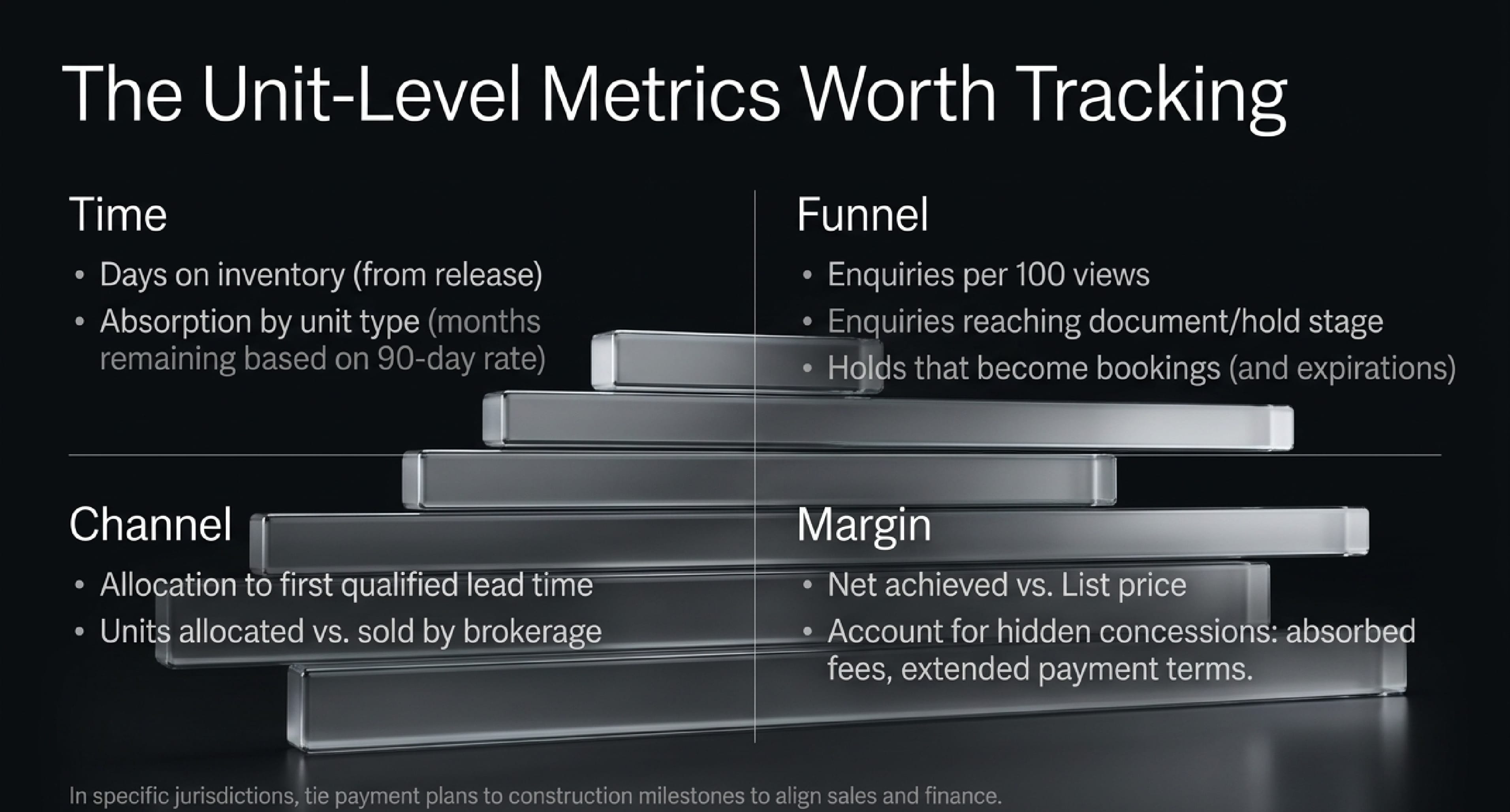
Two regional points belong in the review. Payment plans tied to construction milestones give the tail a funding consequence as well as a sales one, so finance and sales should be reading the same list. And a large share of these buyers sit outside the country, which puts a premium on what they can find out and act on without waiting for someone in the office to be awake. In Saudi Arabia, the Wafi framework carries its own project licensing, escrow governance and regulated disbursement rules, so the same discipline sits inside a different set of requirements.
"This is another report my team has to maintain"
It is a fair concern, and it deserves a direct answer. If the review depends on someone rebuilding a list every month out of a sales tracker, a broker WhatsApp group and a payments file, it will be accurate for two months and then it will not be.
Which is the real reason the tail goes unmanaged. Not that the idea is hard, but that assembling the picture costs more than the meeting is worth.
Where a connected platform helps
The work above gets easier when remaining inventory is one live record rather than several versions of a list.
When the same live inventory sits behind the buyer conversation, the broker allocation and the reservation, a unit's age, its allocation and the activity around it are already together, and the review becomes reading rather than assembling. Moving an allocation from one brokerage to another becomes a decision rather than a project. And the three questions stop being a guess, because the enquiries, broker actions, document requests and holds are already attached to the unit itself.

This is the kind of workflow Proptera is built for, alongside the systems you already run. Its AI agent lets your team approve, hold and reprice by asking for it, lets brokers request allocations, documents and holds without waiting for a callback, and lets a buyer get the payment plan and book at the hour that suits them, each inside their own scope. And Proptera intelligence reads the activity around a project and its units, privately to your account, so a price decision on the tail starts from evidence rather than from the length of the remaining list.
None of that decides the price. You decide the price. It changes what you know when you do.
Start with the oldest project you still have units in
Pull the list of every unsold unit in it, add the date each one was released, and sort by age. Take the top twenty and put the three questions to each one. You will know more about that project in an hour than the percentage-sold figure has told you all year.
If you want to see what that review looks like when the list maintains itself, book a walkthrough and we will run it on your own inventory.
Do the sort this week. The units have been waiting longer than that.