

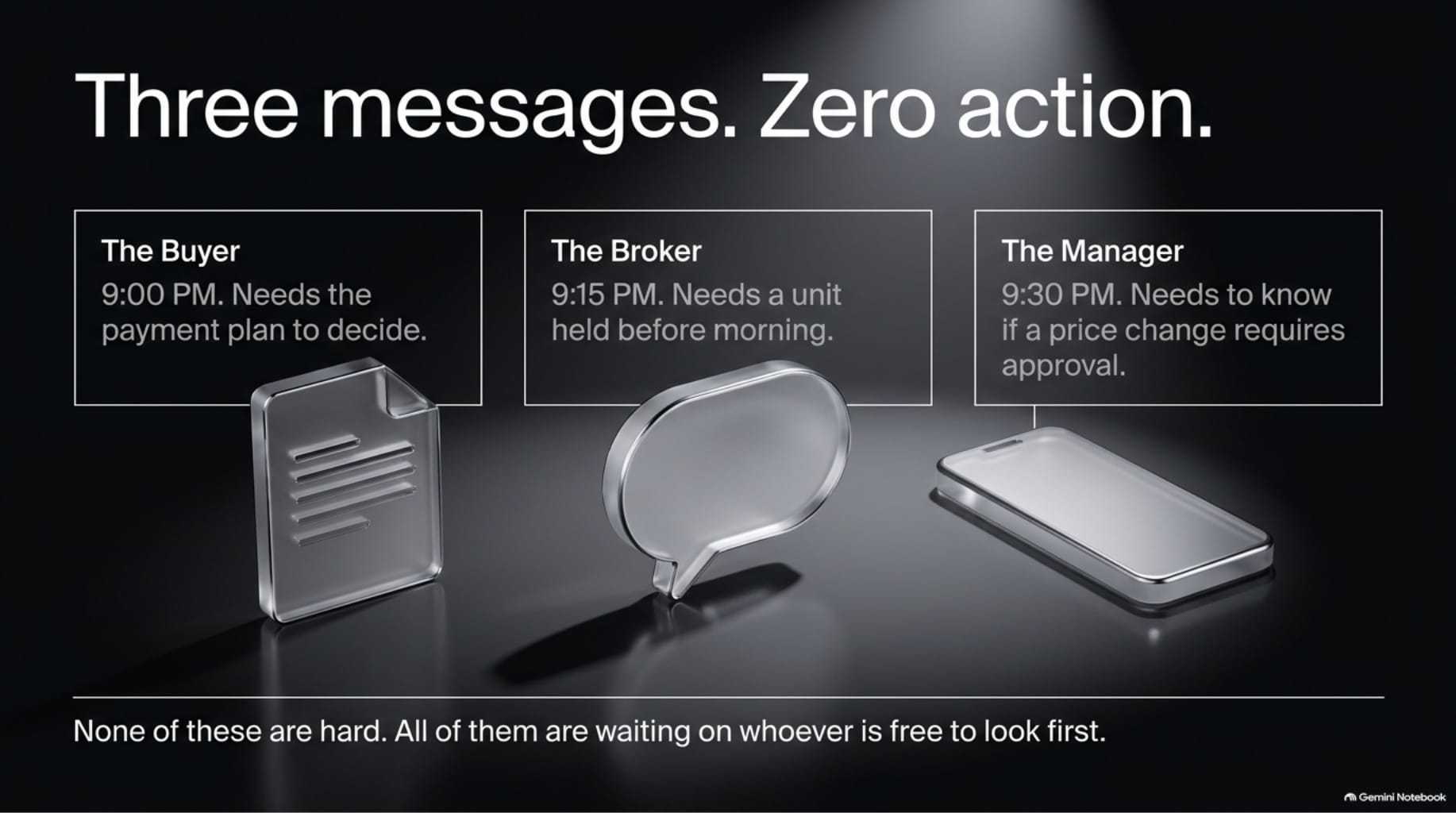
It is nine at night and your phone has three messages on it. A buyer who has been looking at one of your projects for a week has finally decided to move and wants the payment plan. A broker has a client ready to sign and needs a unit held before the morning. Your sales manager wants to know whether a price change on the corner units needs one approval or three.
None of them are hard. All of them are waiting on you, or on whoever on the team is free to look first.
You already know how this ends. The buyer gets the payment plan tomorrow, and tomorrow they are a slightly different buyer. The hold goes in at nine in the morning, if the unit is still there. The price change waits for the meeting. Nothing was dropped. Everything was just late.
This post is about that wait. Why it exists on every growing project, why the obvious fixes do not remove it, and what a night like that looks like once your buyers, your brokers and your own team can get the routine work done by asking for it. By the end you should be able to tell whether the wait is what is holding your next project back, and what to do about it this week.
Part One: Why the wait is not a process failure
Every deal on your project passes through the same few people. That is not a mistake. It is how a sales operation is built. Someone on the team has to know the inventory, the payment plans, the broker allocations and the approval rules, and every question from outside has to reach one of them.
The arithmetic changes as you grow. One project with a handful of brokers is a manageable number of conversations. Add a second project, double the brokers, open the launch to buyers abroad who keep their own hours, and the number of requests climbs a lot faster than the number of people who can answer them. The team is the same size. The queue in front of it is not.
The cost lands in two places, and both of them are on the P&L.
The first is speed. Deals move slower than the interest behind them. A buyer who is ready at nine at night is paying full attention for an hour, maybe two. A complete answer inside that window closes. The same answer at nine the next morning arrives after the moment has passed, and now it has to reopen a decision the buyer has already half made somewhere else. Multiply that by every enquiry that lands outside office hours, on every project, and you are watching a share of your real demand cool overnight, every night.
The second is pricing. When the team is answering requests all day, nobody has a spare hour to look at what buyers and brokers are actually doing on a project before a discount goes out. So the discount goes out on instinct, or on the loudest broker's opinion, and it goes on units that would have moved at the list price. Margin leaves quietly, one unit at a time.
Neither cost shows up as a failure. The team is working hard and the numbers still come in. It only becomes visible when you try to take on the next project with the same people and find that the queue, not the market, is what sets the pace.

Part Two: The obvious fix, and why it stops working
The natural answer is more capacity in front of the queue. Hire another coordinator. Put a second person on the broker WhatsApp group. Ask the sales team to keep their phones on later.
It works, and it is what most developers do, right up to the next project. Then you need another coordinator, and another group, and the evenings get longer. Each new person is one more inbox the request can sit in, and the buyer at nine at night is still waiting for a human to be free. You have bought time. You have not changed the shape of the problem.
The shape of the problem is that every request, however routine, needs a person on your side to receive it, check what is allowed, open the right screen and do it. A payment plan, a document, a hold, a booking, a price change, an approval. The judgement in those requests is small. The handling is what eats the hours.
The change that actually removes the wait is to let each side of the deal get its own routine work done directly, inside the scope you have already set for them, so the team is only in the conversations where it is needed.
That is what the Proptera AI agent is. It is not a chat window that answers questions and then asks someone to log in. What a user can do in the Proptera interface, they can now do by asking. The agent completes the work, and it does so for three sides of the same deal:
- A buyer can ask about a project, get the payment plan and files, complete KYC and create a booking.
- A brokerage can request an allocation, ask for documents and project detail, have a unit held for a client, log a lead, and hand over a buyer who is ready for KYC and booking.
- Your own team can approve, hold, reprice and pull analytics without going through the admin panel every time.
Each one sees only their own scope. A brokerage acts inside the allocation and permissions you gave it and nothing beyond. The interface is still there for anyone who prefers it. The agent is another way in, and it is reachable over WhatsApp, which is where most of these conversations already happen.
Part Three: What the same night looks like
Take the three messages from the opening and run them again, on a project that is on Proptera.
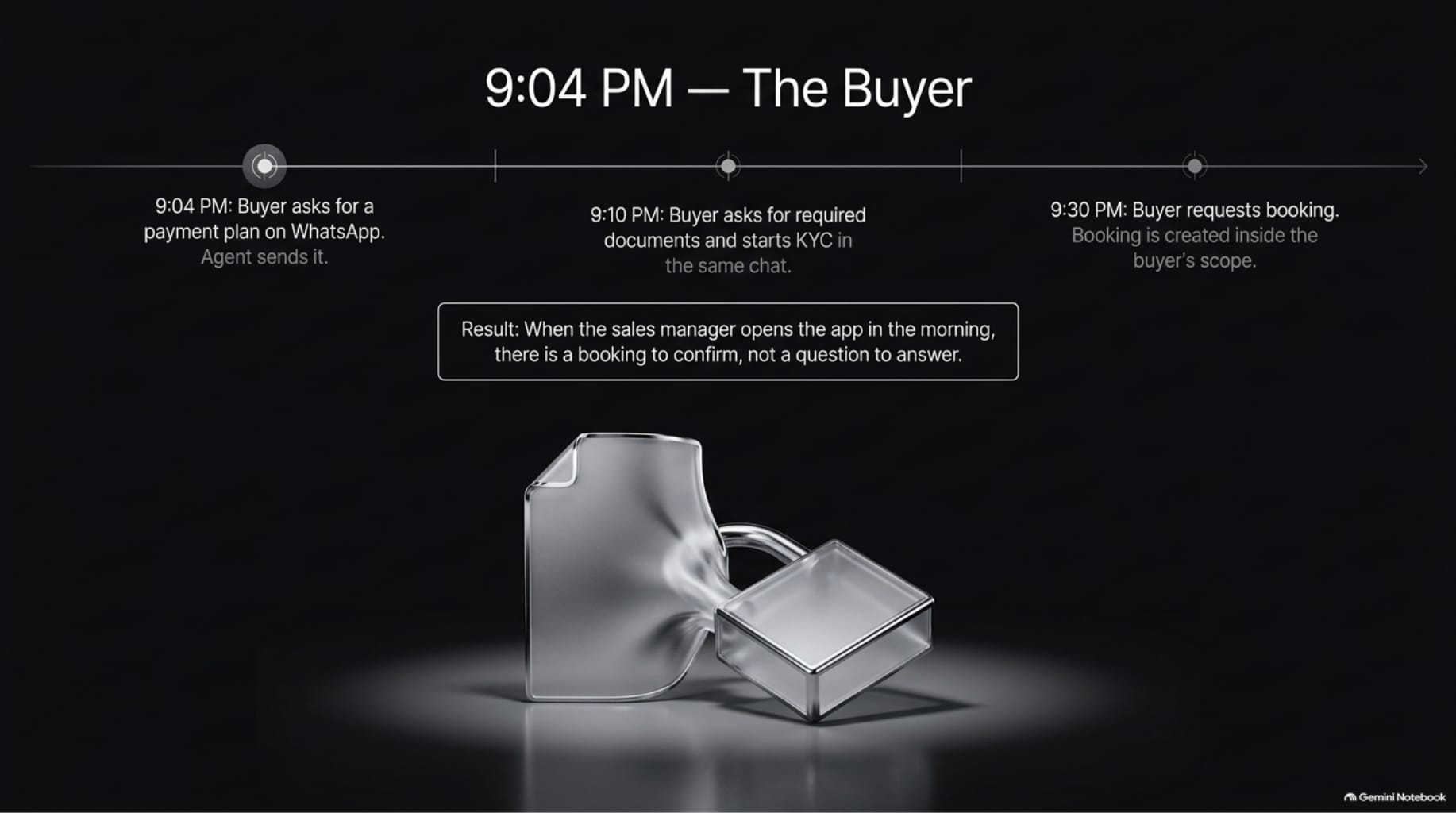
9:04pm. The buyer messages the agent and asks for the payment plan on the two-bedroom they have been looking at. The agent sends it. The buyer reads it, asks what documents they need, and starts KYC in the same conversation. By 9:30pm they have asked for the unit to be booked, and the booking exists, inside the buyer's own scope, with nobody on your team involved yet. When your sales manager opens the app in the morning there is a booking to confirm, not a question to answer.
9:40pm. The broker messages the agent and asks for a hold on a unit for their client. The agent checks that the unit is in the brokerage's allocation and that a hold is allowed under the project's hold policy, and places it. The broker sends the confirmation to their client before ten. The unit is not sold to someone else in the morning, and the broker did not spend the evening chasing anyone.
8:30am. Your sales manager asks the agent whether the corner units are drawing interest before signing off on the price change. Proptera intelligence reads heat maps, WhatsApp conversations, broker actions and buyer actions on your own project, and shows which units people are actually moving toward. The corner units are. The price change goes ahead as an increase, not a discount, and the manager approves it through the agent without opening a single screen.
Three requests. Two of them finished before anyone on your team looked at their phone. The third took one question instead of a meeting, and it protected margin instead of giving it away.
Now scale that. Say the project has 200 units and a dozen brokerages, and a third of enquiries arrive outside office hours. That is not an unusual project. Every one of those enquiries now gets a complete answer while the buyer is still paying attention, and every hold and allocation request from a broker runs the moment it is asked, inside the rules you set. The team's day is spent on the conversations that need a person: the negotiation, the difficult buyer, the brokerage that wants a bigger allocation. It is what the platform is built for: the same team carrying several times the inventory, brokers and buyers it carries today.
Part Four: The fear
If you have read this far, you have an objection, and it is probably one of these.
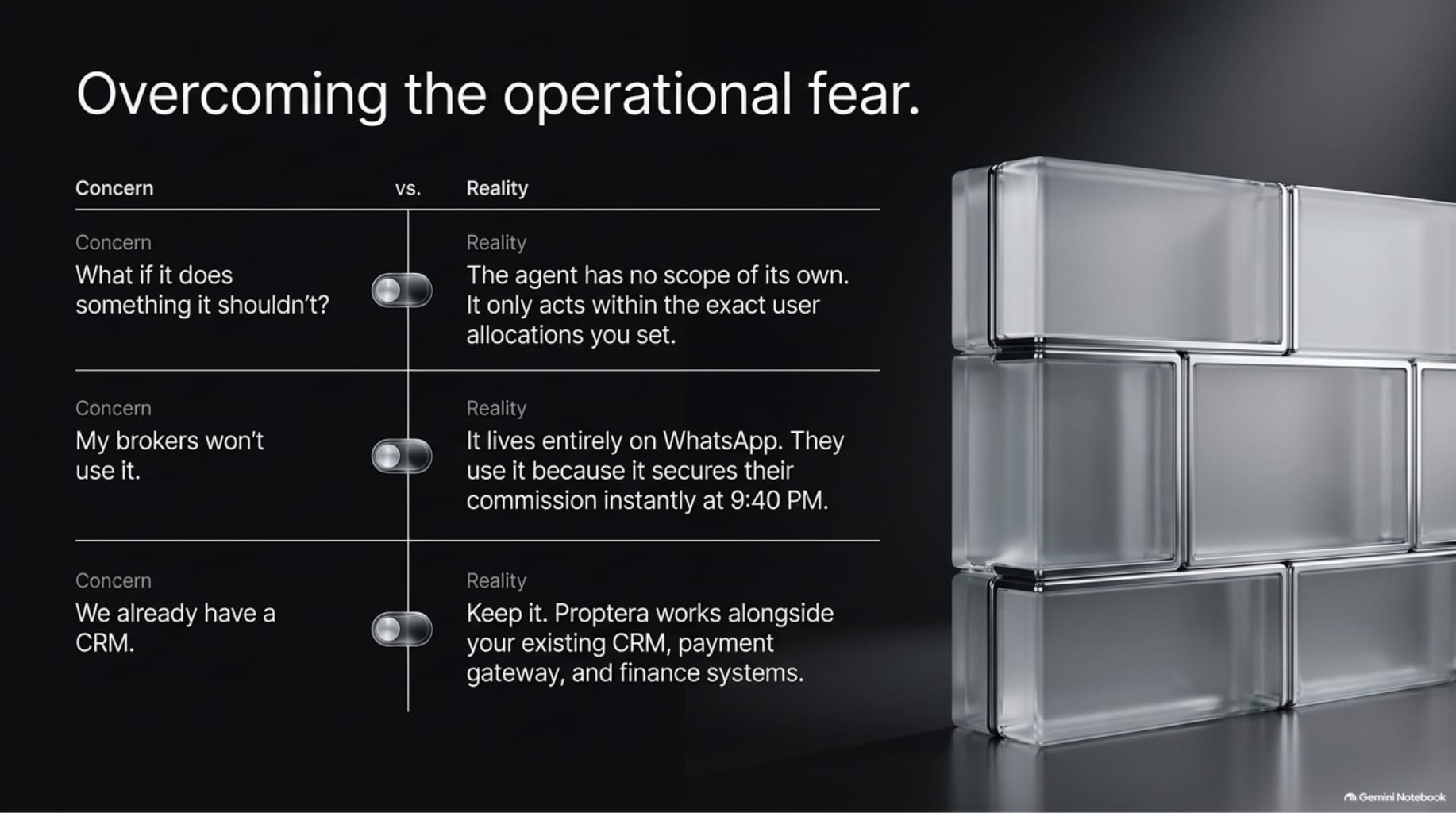
What if it does something it should not? This is a fair concern, and it deserves a direct answer. The agent works inside the same permissions and allocations that already govern the interface. A brokerage can only hold what has been allocated to it. A buyer can only book what is available under the hold policy. Your team's approval rules are the same rules, asked for in words instead of clicked through in a panel. The agent does not have a scope of its own. It has the user's.
My brokers will not use it. They will use WhatsApp, which is where the agent already is. A broker who can hold a unit for a client at 9:40pm without waiting on anyone has a reason to use it that has nothing to do with your preferences and everything to do with their commission.
We already have a CRM, a payment gateway and a finance system. Keep them. Proptera works alongside what you already run. The agent takes the routine handling off the team's desk. It does not ask you to move your operation somewhere else.
What about the units nobody is asking about? Proptera intelligence shows those too, and it is personalised to your account and never shared. You see your own units. A brokerage sees only what is allocated to it and its own live pages. The units sitting still are the ones to discount, on evidence, and the ones drawing interest are the ones to hold the price on.
How to start
The honest way to judge any of this is on your own inventory, not on a demo. That is what the Proptera pilot is for, and it is built so that you do none of the setup work.
- We load your projects, your units and your payment plans.
- We set the agent up for your team, your brokers and your buyers.
- We bring your brokerages on and get their allocations running.
- We run one project alongside your own people.
What you have on day one is a working system with your own inventory in it, your own brokers on it, and an agent your buyers can already message. One project, real work, our people next to yours. When it has proved itself, it extends to the rest.

What to do this week
Pick the project where the wait is costing you the most. It is usually the one with the most brokers on it, or the most enquiries from buyers abroad. That is the project to run the pilot on.
Send us that project, and we will walk through it with you on your own inventory.
Then let the nine o'clock buyer book at nine.