

Somewhere this week, someone on your sales team sent a project brochure to a buyer on WhatsApp. A broker did the same for a client of their own. Behind that one message sits much of the work that went into the launch: the campaign, the sales centre, the renders, the payment plan your commercial and finance teams spent weeks agreeing.
Then the file left, and you learned very little about what happened next.
It may have been opened that evening, or not at all. It may sit on one phone, or it may have been forwarded to a family group and an advisor. The buyer may have gone straight to the payment plan, or spent ten minutes on the floor plans and never reached the page on returns. A lead record shows a name, a source and a stage. It does not usually show any of that.
This piece is about the stretch between an enquiry and a decision: what a buyer reveals there, why so little of it reaches the people running the project, and what becomes possible when it does.
The part of the sale nobody reports on
A buyer, and an investor in particular, does much of their thinking away from your team. Some are deciding from another city or another country. They sit with your material and, often, with a consultant or property advisor. They set the payment plan against another project's, work out the return, and go back to the same floor plan three times.
All of that is information about demand, and it is unusually specific. It shows what the buyer is weighing, which is not always what they said on the call. When the material is a static file passed from phone to phone, very little of that behaviour is captured.
What does reach you are the two ends of the process: the enquiry at the start, and the reservation or the silence at the end. The middle, where the decision forms, leaves little behind.
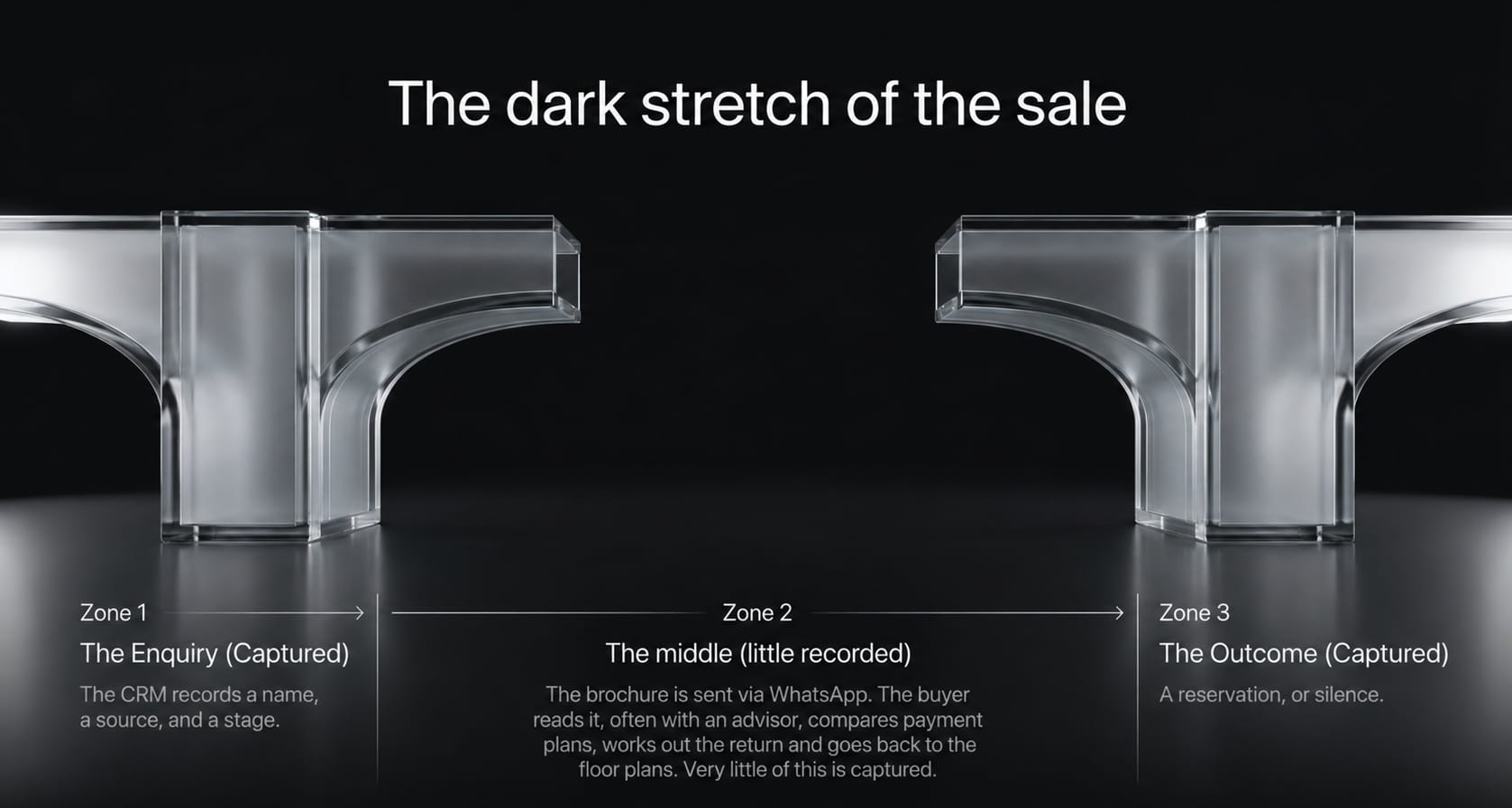
A familiar habit grows out of the same gap. Many sales teams and brokers keep some detail back on WhatsApp or over the phone. The reasoning is understandable: with everything in hand, the buyer has less reason to visit the sales centre. Information is held back partly because sending it returns nothing. Yet many serious investors expect enough information early to assess an opportunity properly, often with an advisor or consultant.
How one gap travels through the operation
This could be filed under follow-up and left with the sales team. It reaches further than that.
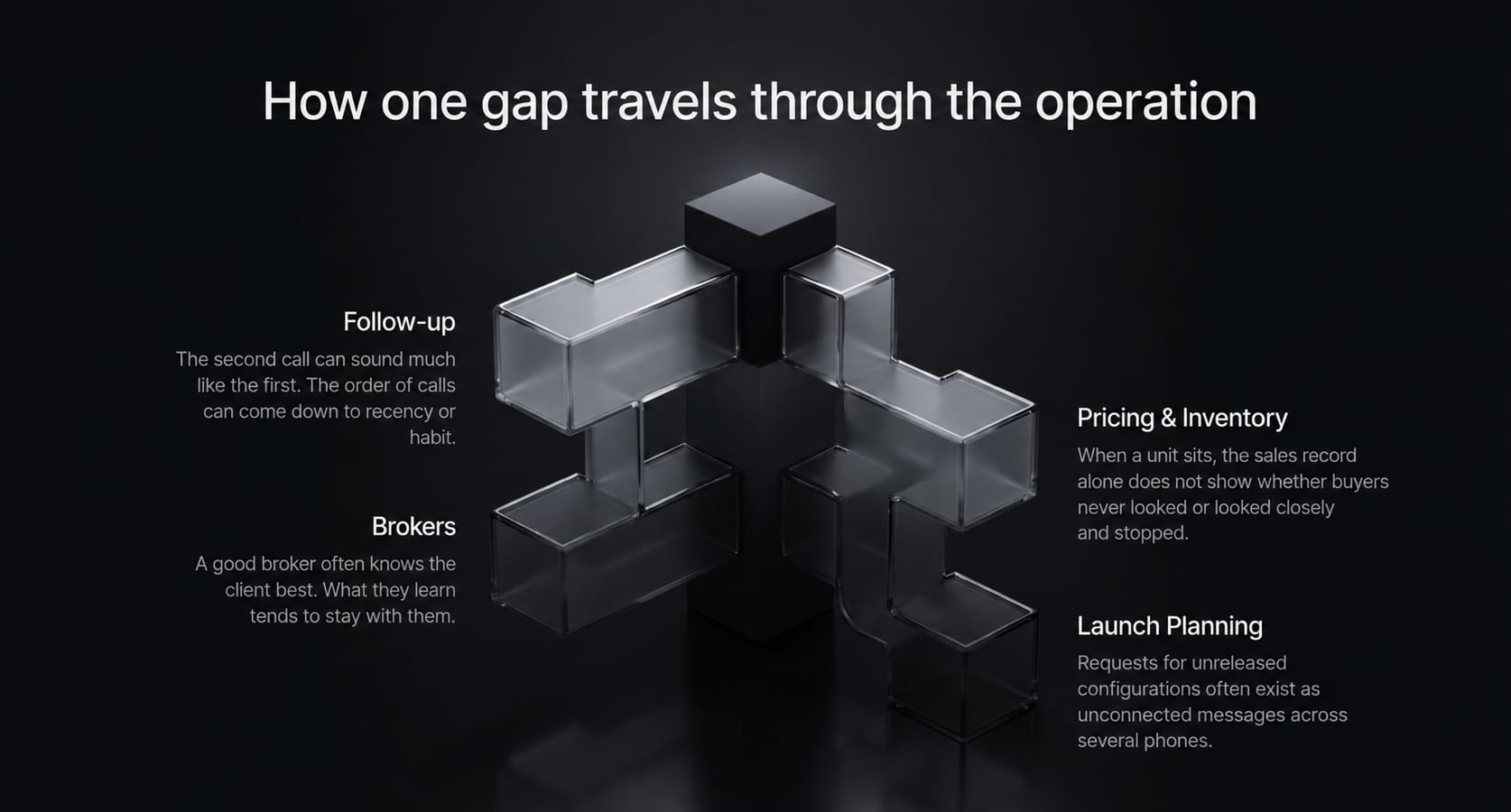
Start with the follow-up itself. With no view of what a buyer looked at, the second call can sound much like the first. "Did you get a chance to look at the brochure?" is a fair question. It is also one the buyer is hearing from other projects this week.
Prioritisation is next. Two leads from the same campaign, at the same stage, can look much the same in a pipeline view. One has been through the payment plan four times in a week. The other never opened the file. Without that difference, the order they are called in can come down to recency or habit.
Brokers are a different case. A good broker often knows their client better than anyone on your side does. What they learn in those conversations tends to stay with them, so you see the reservation they bring and much less of the interest they met along the way.
In the weekly review, a sales head will usually see enquiries, meetings and reservations. Those are outcomes. The reasons a deal slowed (a handover date, the size of the down payment, a floor plan that was not in the pack) often arrive as anecdotes. An objection raised by one buyer is a conversation. The same objection raised by fifteen is a commercial finding, and unless someone is counting, it stays an anecdote.
Marketing may know where a lead came from and have an estimated acquisition cost. It learns far less about which parts of the collateral did the work: whether buyers read the page on returns, passed over the amenities, or went looking for a floor plan that was not there. Those are the things the next brochure would be built on.
Then pricing and inventory. A completed sale tells you the price one buyer accepted under one set of terms. It says little about the other buyers who studied that unit the same week. And when a unit sits, the sales record alone will not tell you whether buyers never looked at it or looked closely and stopped, and those call for different responses.
Launch planning is last. If buyers keep asking for a configuration you have not released, that is among the most useful things one launch can tell you about the next. It often exists as a handful of unconnected messages across several phones.
Each of these is small on its own. Together they mean management reporting tends to describe what was sold in detail, and what was wanted far less.
What a lead record does not tell you
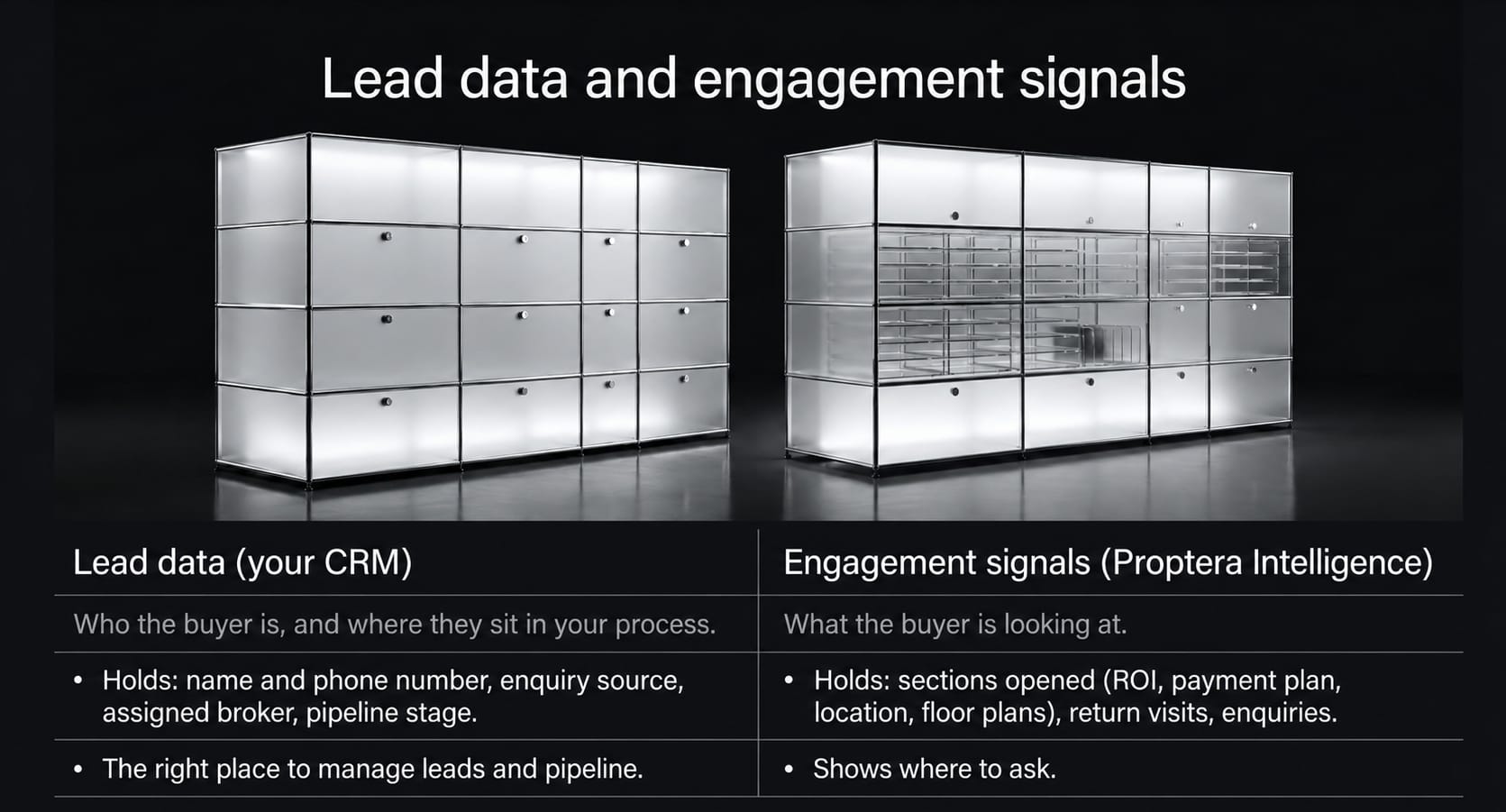
A conventional CRM record typically holds lead data: name, phone number, enquiry source, assigned broker and pipeline stage. That tells you who the buyer is and where they sit in your process, and it remains the right place to manage both.
Where the buyer is in their own decision is a different kind of information. Call it buyer intent. Is this buyer weighing the return, or the payment schedule? Do they keep going back to the location, or to one particular unit? Did they look once, or four times across two weeks?
Some of that intent is stated. Buyers say what they want on calls and in messages, and a careful salesperson's notes are worth a great deal. But notes record what the buyer chose to say, as one person remembered it. What the buyer does with the material is a second kind of signal, and it belongs alongside what they say.
So the question is a practical one: where does the buyer do their reading, and can that place report back, with their knowledge and consent?
A brochure that reports back
That question is what Proptera Intelligence was built around. It works alongside the CRM and the channels you already use, and adds the signals a lead record does not usually hold.
The project is shared as a live page. Your team and your brokers still send a link, much as they do today. Part of the page is open to anyone. The deeper detail sits behind a short verification step, where the buyer confirms an email address and phone number and gives their consent, accepting the privacy terms, before going further.
From that point, what they open is recorded: the ROI, the payment plan, the location, the floor plans, any enquiry they make. The developer can see it, and so can the broker working with that buyer.
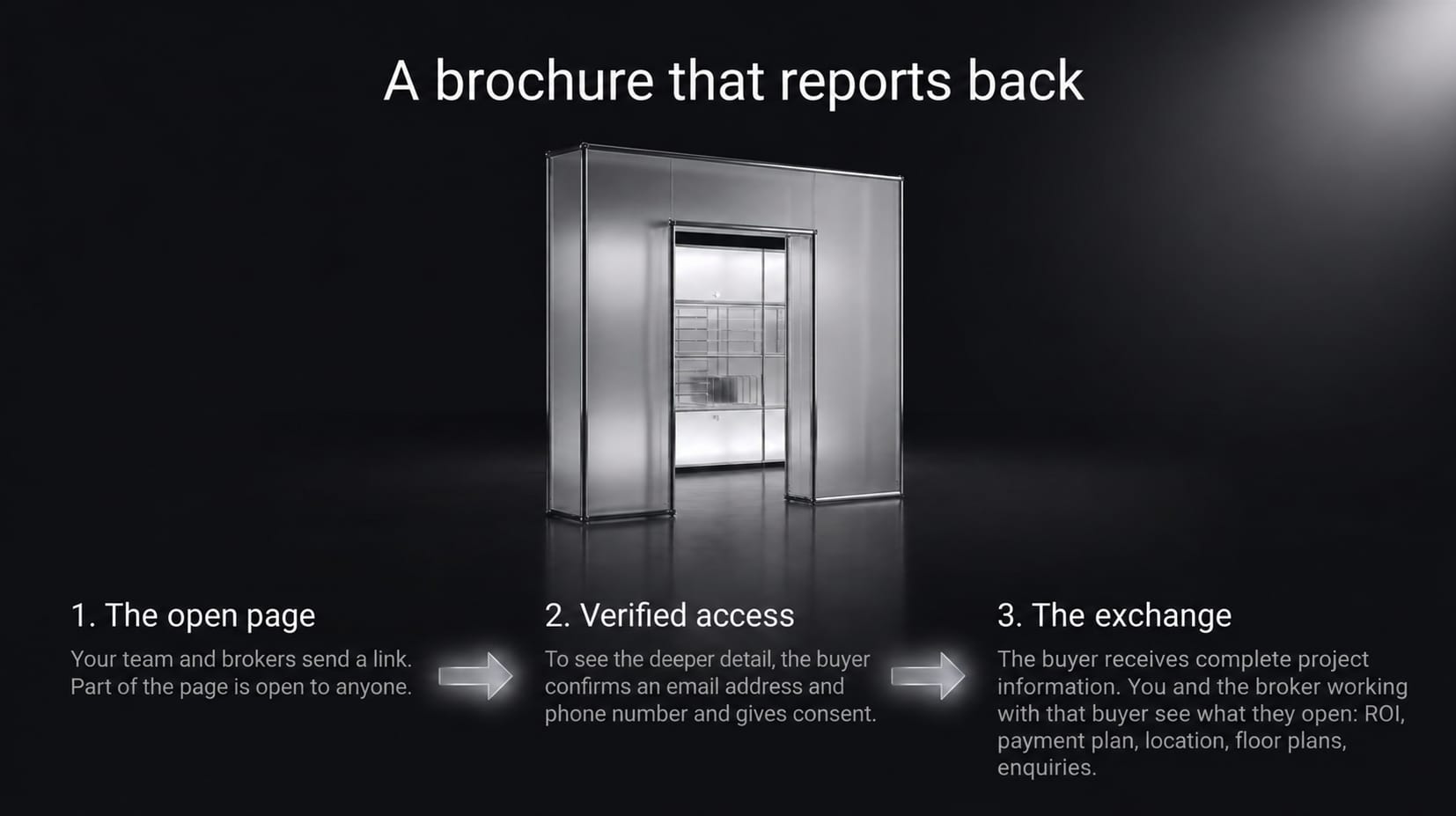
It is a reasonable worry that buyers will object to this, and it deserves a direct answer. It is done in the open. The buyer chooses to verify, agrees to the terms first, and receives complete project information in return. A buyer who prefers not to can still read the open part of the page. This is verified, consented engagement, and the exchange runs both ways: the buyer shares their details, and you share the project freely.
That changes the old caution about sharing. When a brochure returns nothing, holding detail back is understandable. When the page shows you what the buyer read, sharing more is how you learn more.
Three buyers at the same stage
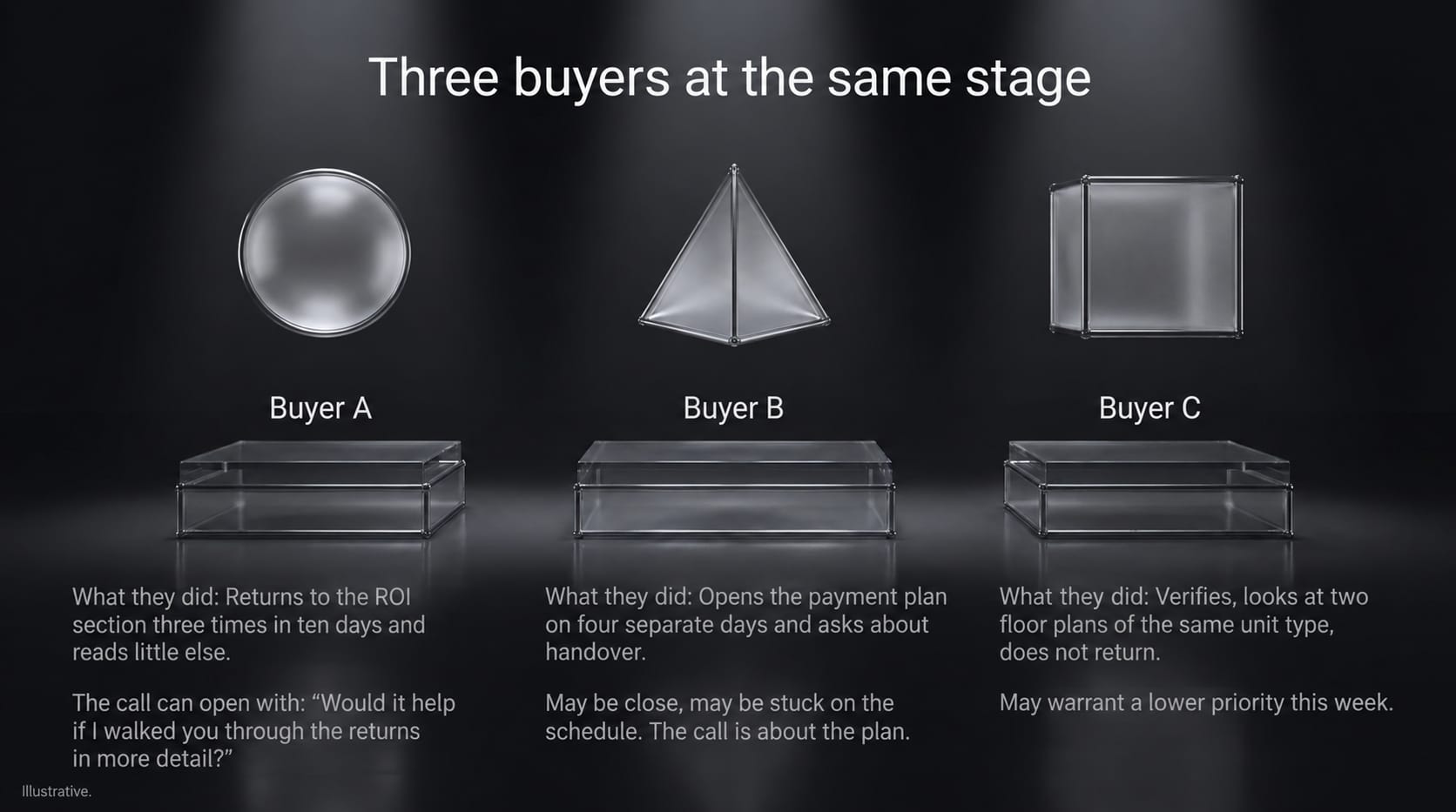
Take an illustrative case: three buyers on the same project who verified in the same week. Same campaign, same stage, brochure sent.
The first comes back to the ROI section three times over ten days and reads little else. That suggests the returns are what they are weighing. The sales manager's call can open with "would it help if I walked you through the returns in more detail?"
The second opens the payment plan on four separate days and sends an enquiry about the handover date. That may mean they are close, or that something in the schedule is giving them pause. Either way the call is about the plan, and the conversation will show which.
The third verifies, looks at two floor plans of the same unit type, and does not return. That lead may warrant a lower priority than the other two this week.
Three similar records have become three different conversations. In each, the record suggests where to begin, and the salesperson confirms the rest by asking.
From one buyer to the whole portfolio
The larger value appears when you stop looking at one buyer.
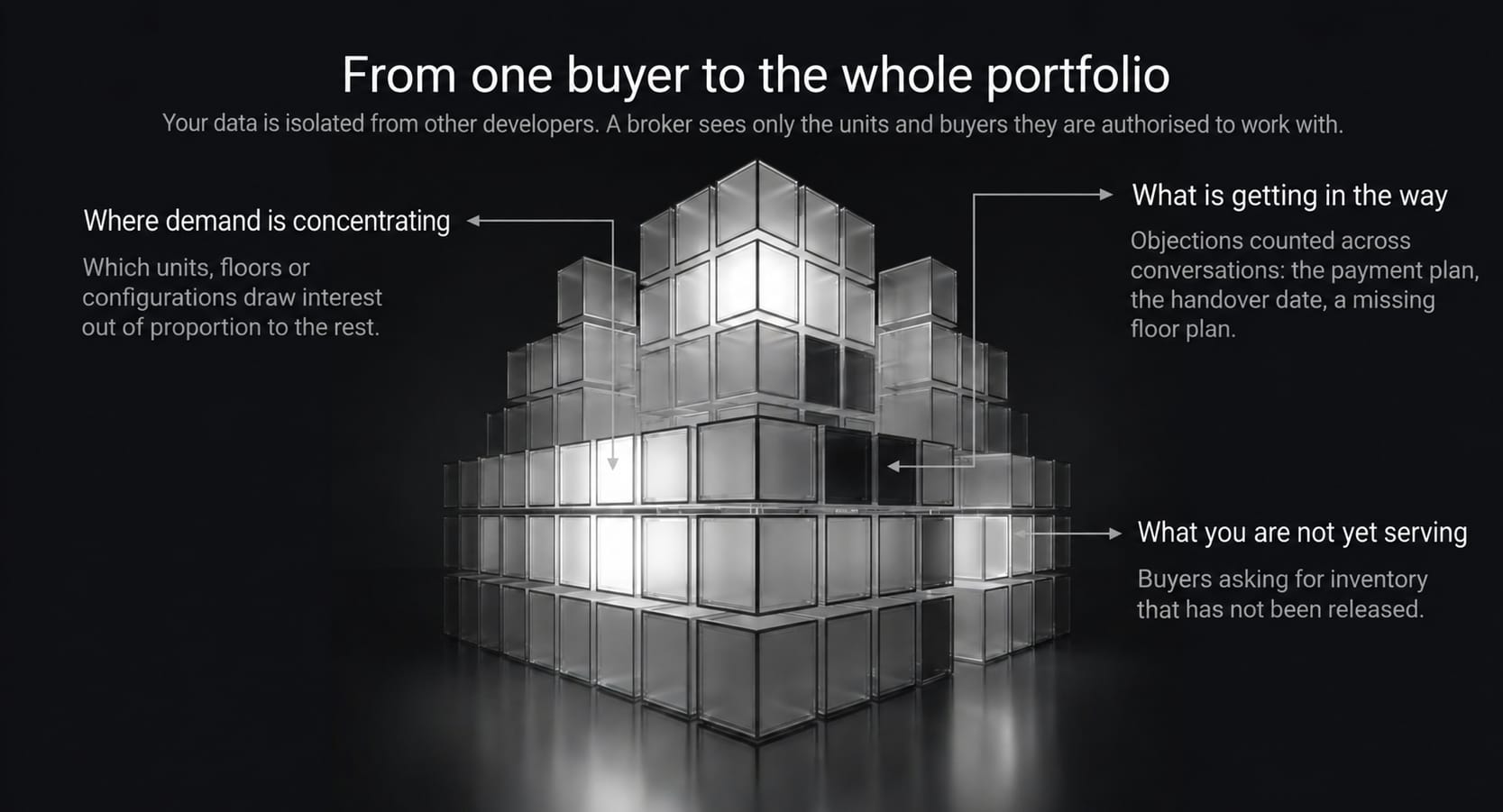
Proptera is the AI-powered intelligence layer for real estate. It holds inventory, buyers and brokers in one system, so Intelligence reads more than page views. Brochure downloads, tour views, payment plan checks, enquiries, WhatsApp conversations and broker actions all feed one picture, set against your actual units. You see it across the portfolio and down to a single unit, as a heat map of where interest is landing. Your data is isolated from other developers, while a broker sees only the units and buyers within the scope they are authorised to work with.
Read across a project, that picture shows things no single conversation can.
It shows where demand is concentrating: which units, floors or configurations draw interest out of proportion to the rest, and which are seen but stay quiet.
It shows what is getting in the way. Objections are counted across conversations instead of recalled from them, whether that is the payment plan, the handover date or a floor plan that is missing.
And it shows what you are not yet serving. The illustration on Proptera's own site is 18 buyers asking for a one-bedroom in a single week, with none released.
Reading the signals with care
Evidence of this kind is easy to over-read, so it helps to be plain about what it can and cannot tell you.
It is a record of observed engagement, not a census of the market. Some buyers stop before verifying. Some deal only with a broker, or receive material another way. The picture is as complete as the activity that passes through it, which is one reason it matters that brokers share the same page.
Repetition carries more weight than a single visit, but the same signal can point two ways. A buyer who keeps returning to the payment plan may be close to committing, or may be stuck on it. The record tells you where to ask the question. The conversation supplies the answer.
Attention is not progress. A unit that is seen often and enquired about rarely is telling you something, but not necessarily that the price is wrong. It could be the payment terms, the information on the page, the configuration, or what else is on the market.
And timing depends on context. How long a pattern needs before it means something varies with the stage of the launch, the volume of activity and the campaigns running.
From signals to decisions
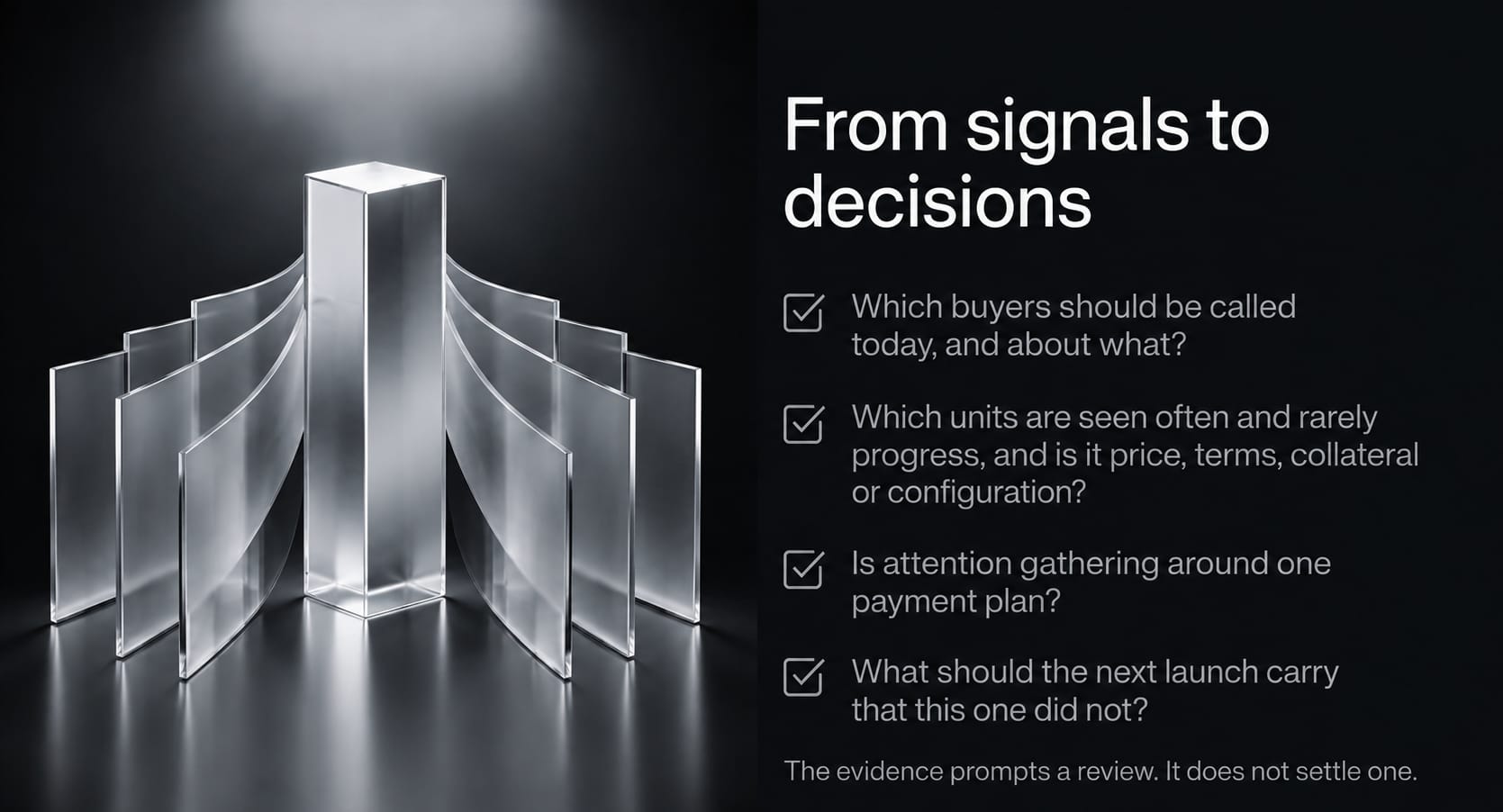
This evidence helps with questions a senior team already asks:
- Which buyers should be called today, and about what?
- What should a broker raise when they follow up?
- Which units are drawing unusually strong interest compared with similar inventory?
- Which objection keeps appearing, and would a clearer document or a different plan answer it?
- Are buyers asking for inventory we have not released?
- Is attention gathering around one payment plan?
- What should the next launch carry that this one did not?
On pricing, the evidence prompts a review. It does not settle one. A unit drawing steady, repeated interest may justify a look at its price. A unit that is seen often and rarely progresses is worth investigating, across price, payment terms, collateral and configuration, before anything is discounted. Intelligence narrows the question. Your commercial team still answers it, with the cost basis, the commercial plan and the read of the market that only they have.
Where a decision does follow, the action is close by: releasing units, publishing a plan, or sending a targeted offer to the buyers who asked.
What changes is that demand becomes something you can see while it is forming, where much of it would otherwise show up only in the transaction.
What the collateral is for
One of the core jobs of project collateral is to carry information to the buyer. A PDF does that well, and it will go on being used.
What has changed is that sharing a project can now do a second job at the same time. It can produce evidence: what was read, how often, and what buyers asked for that was not there. Moving a brochure onto a web page is the small part of this. The larger part is that the stretch between enquiry and decision can now leave a record your sales and management teams can read and act on.
That is the thinking behind Proptera Intelligence, and the test works with or without it. Take the last ten brochures your team sent and ask what each buyer read.
Whatever comes back is your current view of demand before the sale.
See it on your own project
If you would like to see what those ten brochures would show as a live project page, we can walk you through Proptera Intelligence on your own inventory. It takes 30 minutes, and we reply within one business day.